Mahjong Winning Hands, Explained for New American Players
Mahjong winning hands can look mysterious when you are new: a few tiles are exposed, someone says “Mahjong,” and suddenly the round is over. The good news is that most winning hands follow a simple idea. You are trying to complete a legal pattern, but the exact pattern depends on which version of Mahjong your table is playing.
For many traditional styles, the basic winning shape is four sets and one pair. In American Mahjong, the winning hand must match a line on the current card, usually the National Mah Jongg League card used by many U.S. groups. This guide explains both ideas clearly so you can read your hand, avoid common mistakes, and know what to practice next.
What Counts as a Winning Hand?
A winning hand is a complete, legal arrangement of tiles. In most versions, you finish with 14 tiles: the 13 tiles you normally hold plus the final tile you draw or claim to complete the hand.
The important word is “legal.” A hand can look organized and still fail if it does not meet the rule set, the table minimum, or the printed hand you are playing toward. If you are still learning the basics of turns, walls, and discards, start with this What is Mahjong? overview before memorizing hand patterns.
The basic vocabulary
Most Mahjong hand explanations use a few recurring terms. Knowing these makes every rules page easier to read.
- Pair: two identical tiles.
- Chow: three suited tiles in sequence, such as 3-4-5 dots. Chows are common in many Chinese-style games but not part of standard American Mahjong hands.
- Pung: three identical tiles.
- Kong: four identical tiles.
- Quint: five identical tiles or a five-tile group, usually possible only in American Mahjong because jokers exist.
- Concealed hand: a hand that generally must be completed without exposing groups, except for the winning tile under some rules.
If the tile names still feel fuzzy, keep a Mahjong tiles guide nearby. It is much easier to spot winning hands when suits, winds, dragons, flowers, and jokers are second nature.
The Classic Winning Shape: Four Sets and a Pair
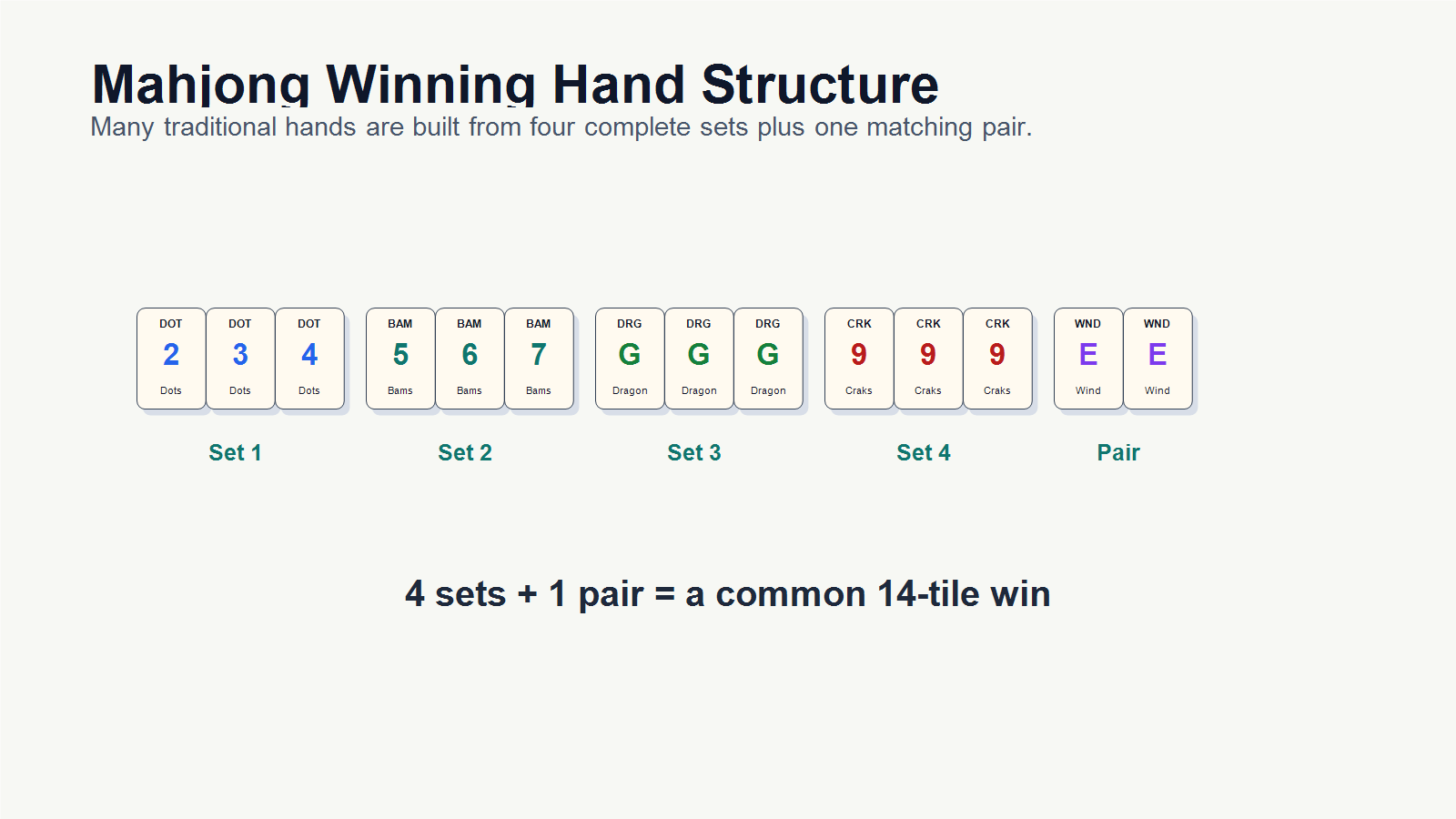
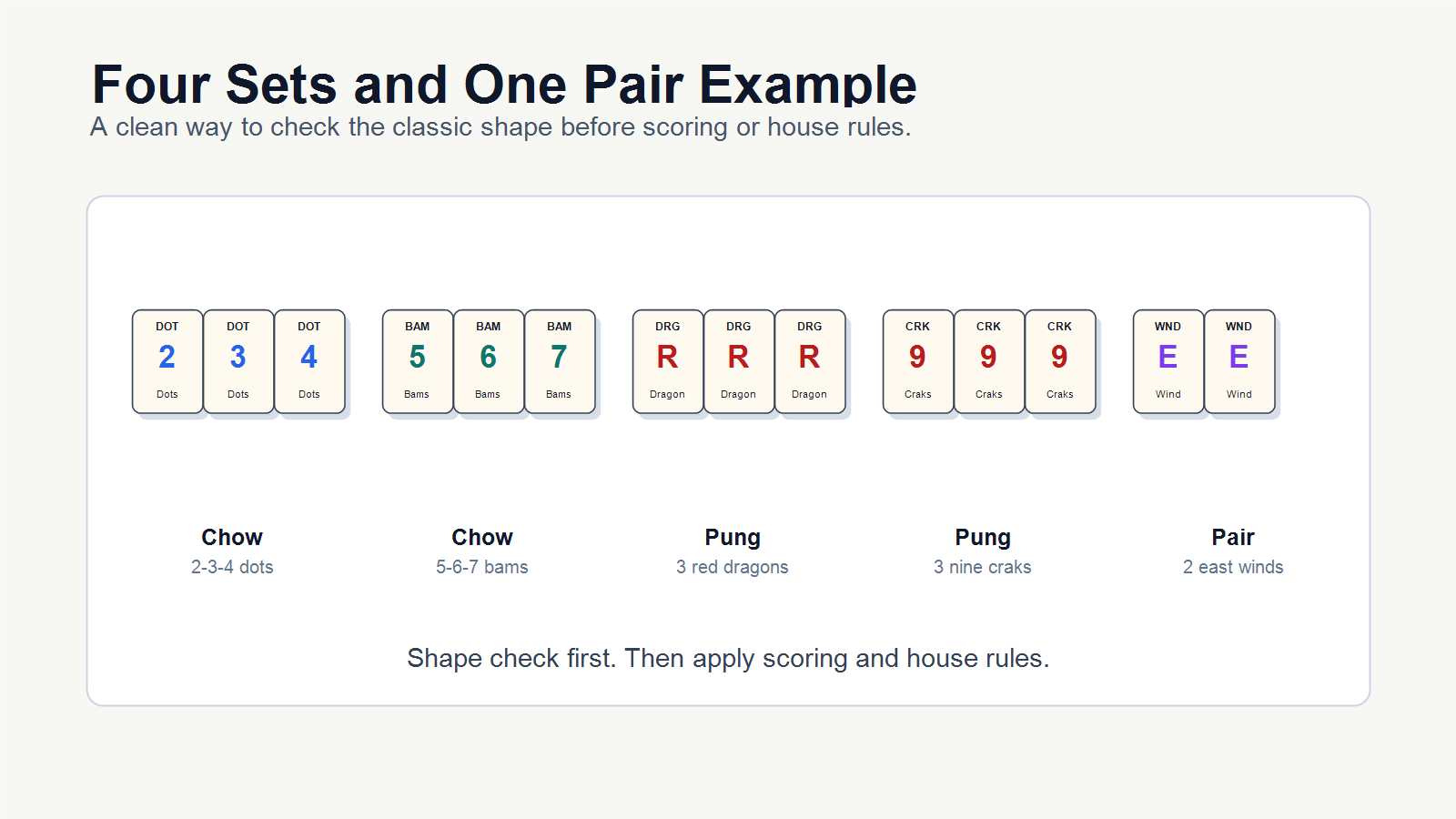
In many traditional Mahjong variants, a standard winning hand is made of four sets plus one pair. The sets may be chows, pungs, or kongs depending on the rules. The pair is often called the “eyes.”
| Part of Hand | Simple Example | What It Means | Common In |
|---|---|---|---|
| Chow | 2-3-4 bams | Three suited tiles in order | Many Chinese-style rules |
| Pung | Three red dragons | Three identical tiles | Traditional and American-style games |
| Kong | Four 7 cracks | Four identical tiles | Traditional and American-style games |
| Pair | Two east winds | The final two matching tiles | Most standard hands |
A simple traditional-style winning hand might be 2-3-4 dots, 5-6-7 dots, three green dragons, three 9 bams, and a pair of east winds. That is four sets plus a pair. Scoring is a separate question, and many tables require a minimum score before a hand can win.
For a broader look at traditional structure, this Chinese Mahjong beginner guide is a helpful companion because it explains the flow of play around those patterns.
How American Mahjong Winning Hands Are Different
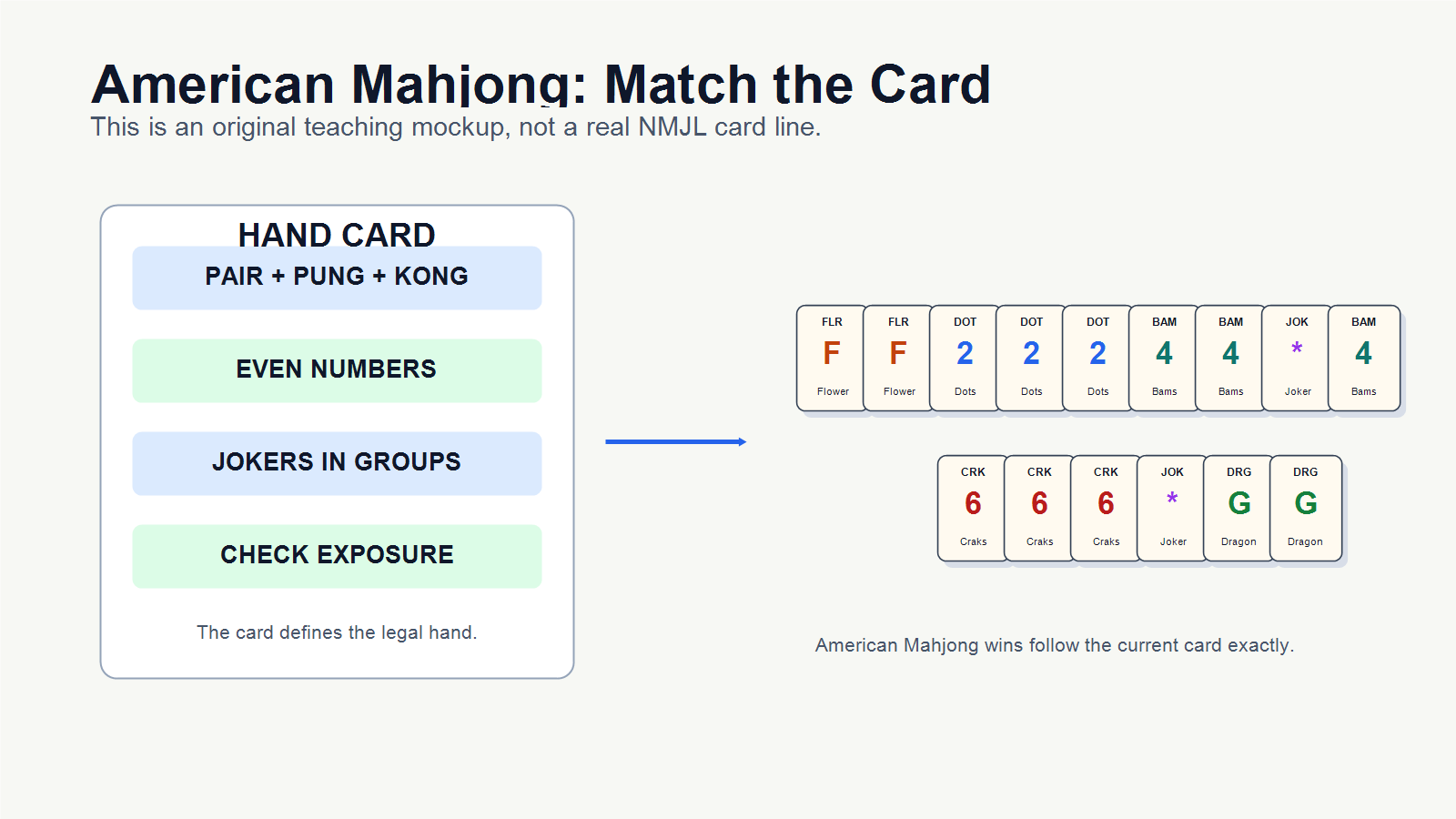
American Mahjong is where many U.S. beginners get tripped up. You are not simply building any four sets and a pair. Instead, you choose a line from the current year’s hand card and try to match it exactly.
Many American groups use the annual National Mah Jongg League card. The card changes each year, so a hand that was printed last year may not be playable this year. For a full table-flow explanation, read the site’s American Mahjong rules guide.
What the card changes
The card turns winning hands into specific recipes. A line might require certain numbers, suits, dragons, flowers, winds, pairs, pungs, kongs, quints, or single tiles. The exact color coding and notation matter.
This is why American Mahjong rewards planning early. After the Charleston and your first few draws, you are usually comparing two or three possible lines and discarding tiles that do not support them.
Jokers help, but not everywhere
Jokers are one reason American Mahjong feels different from many other versions. In common American rules, jokers can help complete larger groups such as pungs, kongs, quints, and sextets. They generally cannot be used as a single tile or as part of a pair.
That one rule explains many dead hands. If a card line needs a pair of flowers, a joker cannot stand in for one of those flowers under standard American play. Always confirm local or tournament rules, especially when you join a new group.
Common Types of Mahjong Winning Hands
The names below are useful because you will hear them in books, apps, and casual table talk. They are not all legal in every version of Mahjong. Treat them as pattern families, then check your rules before declaring a win.
| Hand Type | Plain-English Idea | Beginner Tip |
|---|---|---|
| All Pungs | The hand is built mostly from three-of-a-kind groups. | Watch discards closely because identical tiles disappear fast. |
| Pure Suit | Most or all tiles come from one suit. | Powerful when your opening tiles are already heavy in one suit. |
| Mixed Suit With Honors | One main suit plus winds or dragons. | Often more flexible than forcing a pure suit. |
| Seven Pairs | Seven matching pairs instead of four sets and a pair. | Common in some variants, but not a universal win condition. |
| Card Pattern | A printed American Mahjong line with exact tile groups. | Match every symbol, suit instruction, and exposure rule. |
Older American and classical rule sets can also differ from the modern NMJL-card style. If you enjoy rule history or want to understand why U.S. Mahjong developed its own character, see this guide to American Classical Mahjong.
How to Read Your Hand During a Game
Beginners often stare at 13 tiles and ask, “Is there a win in here?” A better question is, “Which legal hand am I closest to, and what tiles prove it?” That keeps you from chasing pretty patterns that cannot actually win.
Step 1: Sort by suit and role
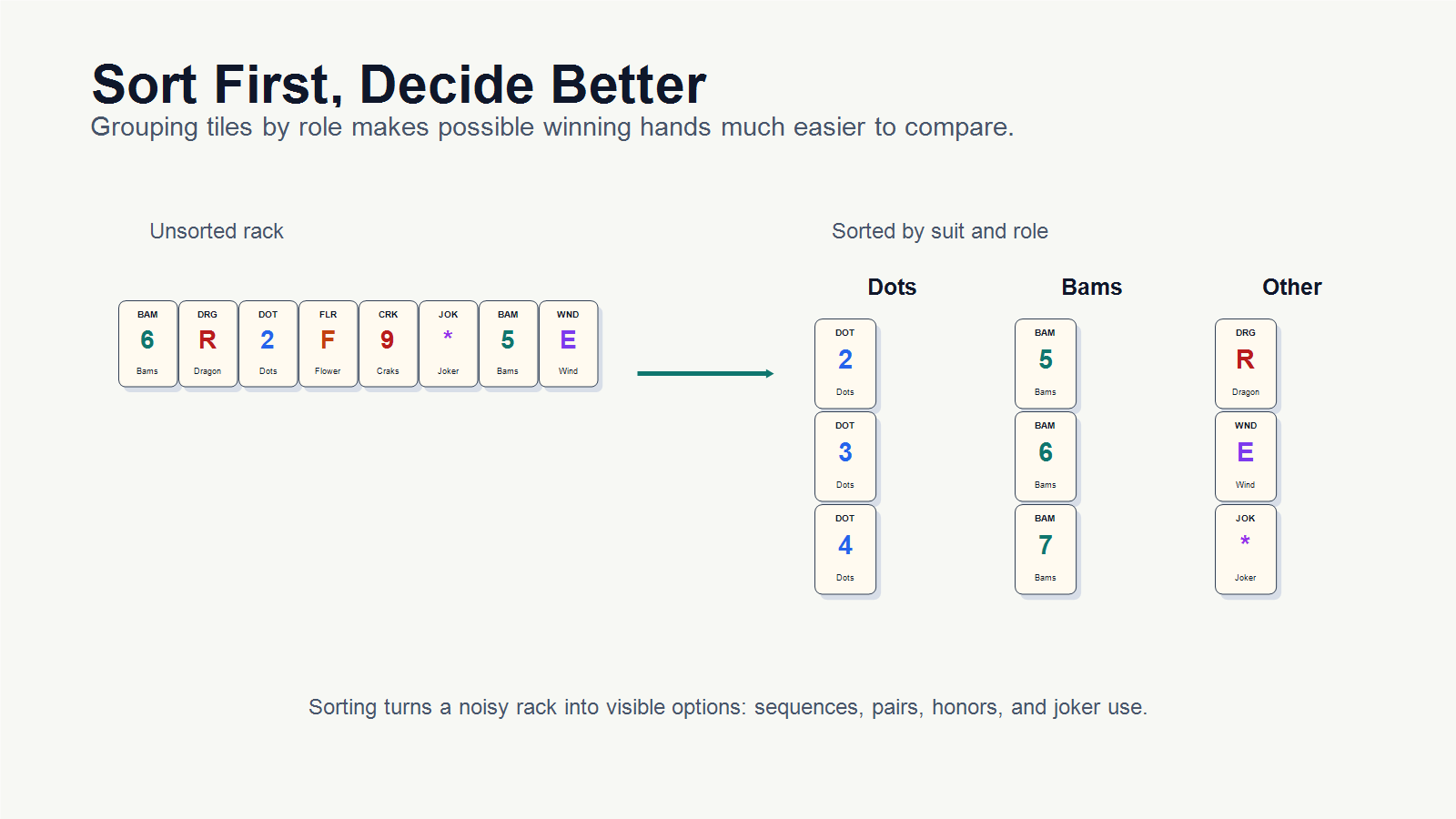
Group dots, bams, cracks, winds, dragons, flowers, and jokers. Sorting makes pairs and near-sets visible. It also shows when you have too many unrelated tiles to chase a narrow hand.
Step 2: Find your anchors
An anchor is a part of the hand you are unlikely to abandon: a pair, a pung, a strong sequence, or a group required by your American Mahjong card. Keep anchors in mind before each discard.
Step 3: Count what you still need
If you need five exact tiles and only one of them is flexible, the hand may be too far away. If two different card lines use the same tiles, you can stay flexible longer.
Step 4: Check exposure rules before calling
Calling a discard can help, but it also reveals your plan and may lock you into one path. In American Mahjong, a concealed hand printed on the card should not be exposed in normal play. In traditional variants, chow and pung calls follow their own restrictions.
A Practical Example: Two Possible Plans
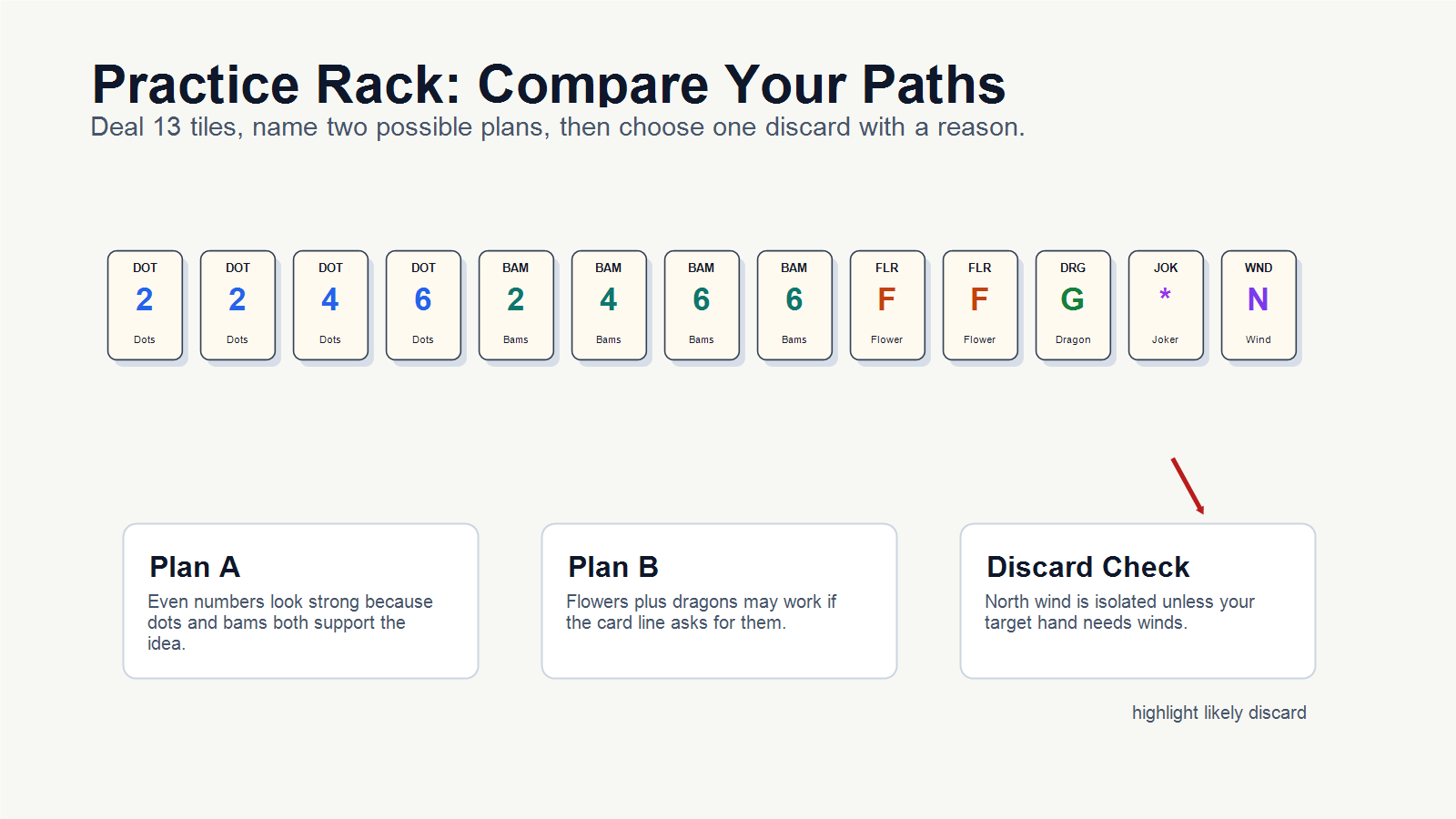
Imagine your American Mahjong rack has several 2s, 4s, and 6s, two flowers, a green dragon, and one joker. One card line may use even numbers in two suits. Another may need flowers and dragons with a kong.
The stronger plan is usually the one with more completed groups and fewer single-purpose tiles. If your joker can support a kong in one plan but does nothing for a required pair in the other, that matters. The joker is not just “wild”; it is useful only where the rules allow it.
In a traditional game, the same thinking still applies. You might compare a clean one-suit hand against a faster mixed hand. The elegant hand is tempting, but the practical hand often wins the table.
Common Beginner Mistakes With Winning Hands
- Mixing rule sets: A valid Chinese-style hand may not be a valid American Mahjong hand, and the reverse is also true.
- Using jokers in pairs: In standard American play, this is not allowed, even when it would complete the hand.
- Ignoring the current card: American Mahjong hands change by year, so old examples are useful for learning logic but not for declaring a current win.
- Calling too early: An early exposure can make your hand obvious and remove flexibility.
- Keeping every pair: Pairs feel promising, but some hands need kongs, pungs, or single tiles instead.
- Forgetting table rules: Scoring minimums, multiple-winner rules, and special hands vary by group.
A Simple Practice Routine
You do not need to memorize every winning hand at once. Practice recognition in short sessions. Ten focused minutes is better than flipping through a card without making decisions.
| Practice Task | How to Do It | What It Builds |
|---|---|---|
| Sort random racks | Deal 13 tiles and group them by suit and type. | Faster pattern recognition. |
| Name two possible hands | Pick two legal lines or two traditional patterns the rack could chase. | Flexibility before committing. |
| Choose one discard | Explain why one tile helps the least. | Cleaner decision-making. |
| Check joker legality | Mark where a joker can and cannot be used. | Fewer dead-hand mistakes. |
FAQ About Mahjong Winning Hands
How many tiles are in a Mahjong winning hand?
Most Mahjong winning hands finish with 14 tiles. During normal play, you usually hold 13 tiles and complete the hand with a drawn tile or a claimed discard. Bonus tiles and kong replacement rules can affect counting in some variants.
Is every Mahjong winning hand four sets and a pair?
No. Four sets and a pair is the common standard pattern in many traditional variants, but special hands exist. American Mahjong works differently because the winning hand must match a printed card line.
Can I use a joker anywhere in American Mahjong?
No. Under common American Mahjong rules, jokers are used for larger groups such as pungs, kongs, quints, or sextets. They are generally not allowed for singles or pairs, but always check the rule source your group follows.
What is the easiest Mahjong hand for beginners?
The easiest hand is usually the one closest to your starting tiles, not the one with the simplest name. In traditional Mahjong, mixed hands with flexible sequences can be beginner-friendly. In American Mahjong, look for card lines that share tiles with your strongest groups.
Why was my Mahjong hand called dead?
A hand may be dead if it cannot legally match a winning pattern, has an impossible exposure, uses a joker incorrectly, has the wrong number of tiles, or violates a table rule. In American Mahjong, exposing tiles for a concealed hand is a common reason.
Do Mahjong winning hands vary by country or table?
Yes. Chinese, American, Japanese Riichi, Hong Kong, Taiwanese, and house-rule games can define winning and scoring differently. Before a game starts, confirm the rule set, scoring minimum, joker rules, and whether special hands are allowed.
Final Takeaway
The fastest way to understand Mahjong winning hands is to separate structure from rule set. Traditional hands often start with four sets and a pair. American Mahjong starts with the card.
Once you know which game you are playing, the hand becomes less mysterious. Sort your tiles, identify your anchors, count what you need, and check the rules before you call. That quiet habit will save more games than memorizing a long list of hand names.