Dead Hands in American Mahjong: A Clear Beginner Rules Guide
A “dead hand” sounds dramatic, especially when you are new to American Mahjong. In practical terms, it means the hand is no longer eligible to win because a rule was broken or the visible tiles cannot fit a legal line on the current card. Most dead hands come from a small set of preventable mistakes, so learning the warning signs is far more useful than worrying about being embarrassed at the table.
What does a dead hand mean?
A dead hand is disqualified from declaring Mahjong for that round. It is not the same as a weak hand. A rack can be far from completion and still be live, while a rack that looks close can be dead if an exposure conflicts with the card or the tile count is wrong.
The distinction matters because American play is card-driven. Your tiles must match one exact line, including its group sizes, suit relationships, exposure status, and Joker limits. If you are still learning that framework, start with the beginner-friendly American Mahjong rules and keep the current card beside your rack.
Common reasons a hand becomes dead
1. An exposure cannot belong to a legal card line
Suppose you call a discarded 5 Dot and expose three 5 Dots. If no line you could legally complete contains that exact exposed group, the visible information may prove that your hand cannot win. This is why a call should never be automatic. Check the card before moving tiles to the top of your rack.
2. A concealed hand is exposed too early
Lines marked concealed require you to keep the hand private during ordinary play. Making a Pung, Kong, or Quint exposure while pursuing one of those lines breaks the requirement. A concealed line may generally claim the final discarded tile needed for Mahjong, but it cannot make an earlier exposure simply to improve the rack.
3. The rack has the wrong number of tiles
Picking twice, forgetting to pick, or mishandling a called tile can leave a player with too many or too few tiles. Count before you discard whenever the turn sequence feels uncertain. The goal is normally 13 tiles between turns and 14 at the moment of a legal win, with exposed groups counted as part of the hand.
4. A call creates an illegal group
A discard may normally be called to complete a legal group of identical tiles in an exposable hand. It is not an invitation to take any useful tile. Calling for a pair, single, or group that does not match the chosen line can disqualify the hand. Review the American Mahjong terms glossary if Pung, Kong, Quint, and exposure still run together in your head.
5. Mahjong is declared in error
Before announcing a win, compare every group with the card from left to right. Check the suit colors, the number of Flowers, whether the line is concealed, and whether Jokers appear only where allowed. A rack that merely resembles the line is not enough.
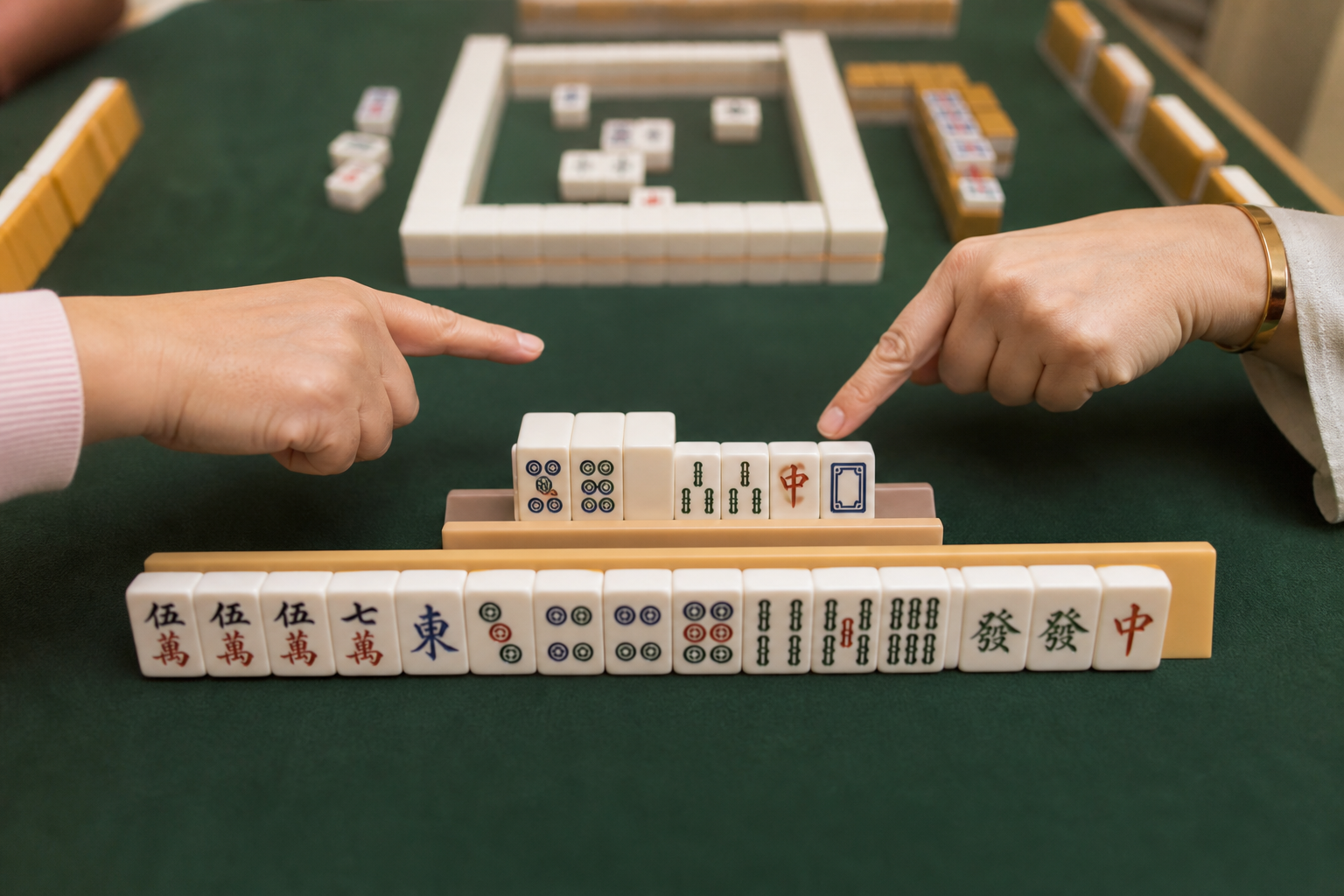
How a dead-hand challenge works
A challenge should be based on information everyone can see, such as exposed groups, discards, or an obvious tile-count problem. It should not be based on guessing the concealed tiles behind another player’s rack. Calmly state the concern and identify the visible reason.
Rules about what happens next can differ among leagues, tournaments, and home groups. Some organized rule sets stop the challenged player from drawing and discarding after the hand is formally declared dead; some casual tables use a “play through” procedure. Agree on the rule source before the first deal. A friendly teaching table should resolve the point once, explain it briefly, and let the round continue without turning the mistake into a debate.
If you notice your own error before anyone challenges it, do not secretly rearrange an exposure. Tell the table that you need a rules check. In a learning game, honesty is more valuable than squeezing a technical advantage from uncertainty.
What should a beginner do after a hand is declared dead?
First, stop and confirm the exact reason. Was the problem the chosen line, the exposure, the tile count, or the declaration? That answer tells you what to practice next. If your table’s rules keep you involved in any way, switch from hand-building to careful table awareness and follow the agreed procedure.
Do not let one dead hand rush your next round. Most experienced players have made an incorrect call or misread a card line. The productive response is to identify the decision that caused the problem, not to replay the entire round in your head.
A five-second prevention check
- Before a call: point to the exact group on the card that the exposure will satisfy.
- Before using a Joker: confirm it is inside a group of three or more, not a single or pair. See the full American Mahjong Joker rules.
- Before discarding: make sure your rack has the correct number of tiles.
- Before declaring Mahjong: read the line from beginning to end and compare every group.
- When uncertain: say “hold” before the next player racks a tile, then ask for a rules check.
Dead hand versus an unwinnable-looking hand
A bad draw does not automatically make a hand dead. You may realize that the tiles you need have all appeared, or that a chosen line is no longer realistic. That is a strategic problem rather than necessarily a rules violation. You can still play defensively, watch the discards, and avoid feeding another player. The most common beginner Mahjong mistakes guide explains how to recover when a plan stalls.
Quick questions
Can a dead hand still win?
No. Once the hand has been validly declared dead under the table’s rules, it cannot declare Mahjong in that round.
Can another player challenge based on my hidden tiles?
A proper challenge should rely on visible evidence, not speculation about concealed tiles.
Does one wrong discard make a hand dead?
Usually no. A poor discard may damage your strategy, but a dead hand involves a rules violation or visible impossibility under the applicable rules.