American Mahjong has its own vocabulary, and the words can make a first lesson sound harder than the game really is. Players talk about building a wall, passing across, calling a tile, exchanging a Joker, and declaring Mah Jongg—all while moving quickly around the table.

This plain-English glossary focuses on terms American players use most often. For a full start-to-finish explanation of the game, pair it with our American Mahjong rules for beginners.
Tiles and Equipment
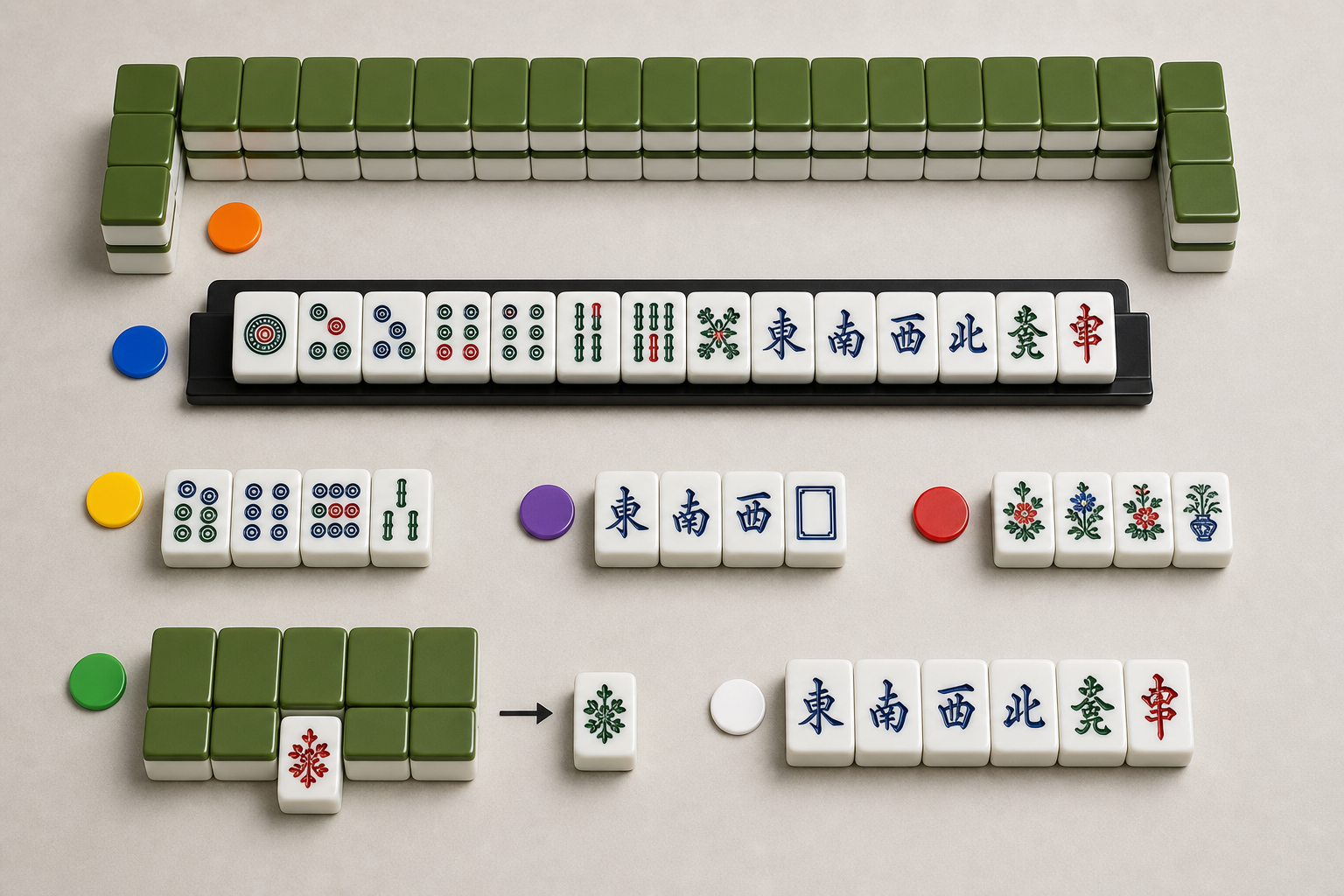
- Bams
- One of the three numbered suits, represented by bamboo-style symbols. Bams run from 1 through 9.
- Craks
- The numbered character suit, also running from 1 through 9. The name is short for characters.
- Dots
- The numbered circle suit. Each tile shows a number of round symbols from 1 through 9.
- Suit tiles
- The Dots, Bams, and Craks. Each suit has numbers 1 through 9, with four copies of every tile.
- Honors
- A general term for Winds and Dragons. Unlike suit tiles, honors do not form numerical runs.
- Winds
- East, South, West, and North tiles. American Mahjong hands may use them as singles, pairs, or larger matching groups.
- Dragons
- Red, Green, and White Dragon tiles. Each is traditionally associated with a suit: Red with Craks, Green with Bams, and White with Dots.
- Flowers
- Special tiles that are interchangeable with one another in American Mahjong. A line asking for flowers usually accepts any flower tiles.
- Joker
- A wild tile that may substitute in many groups of three or more identical tiles. It generally cannot be used for a single or pair.
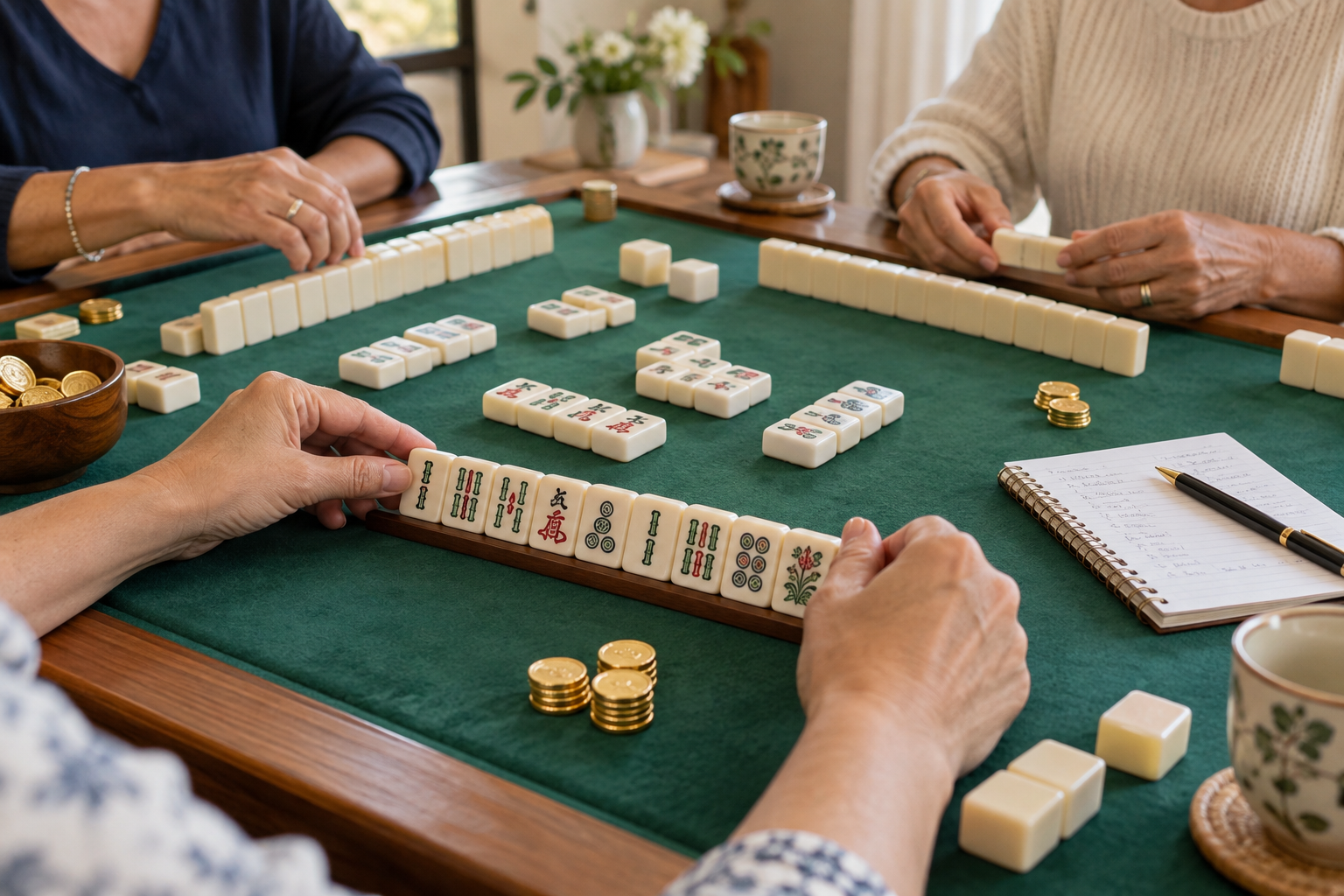
- Rack
- The holder in front of each player. The sloped side hides your tiles; the flat top holds exposed groups.
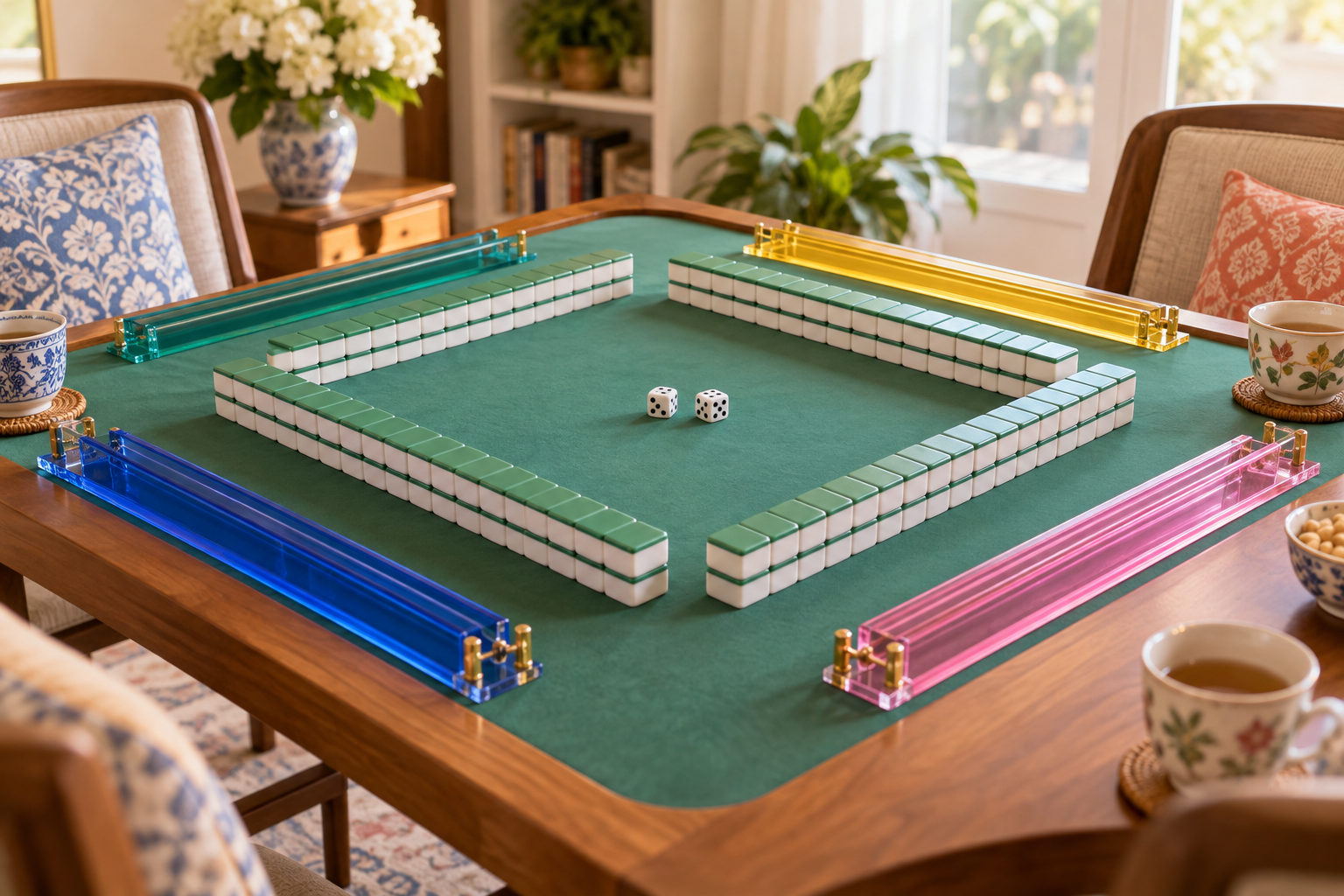
- Wall
- The face-down rows of tiles built before play. Players draw from the wall during the game.
- Pushers
- Optional tools used to move a wall neatly into position without exposing tiles.
See our visual guide to American Mahjong tiles if you want help identifying every category.
Hand-Building Terms
- Single
- One specific tile required by a hand. Jokers cannot replace singles.
- Pair
- Two identical tiles. A Joker cannot normally be used in a pair.
- Pung
- Three identical tiles. A pung may contain Jokers when the card permits the group.
- Kong
- Four identical tiles. In American Mahjong, a kong is simply a four-tile group printed on the card; it does not trigger replacement draws as it may in other variants.
- Quint
- Five identical tiles. Because only four natural copies of a tile exist, a quint needs at least one Joker.
- Sextet
- Six identical tiles. This larger group also requires Jokers.
- Run
- Numbers in sequence, such as 3-4-5. American Mahjong uses runs only when a specific card line calls for them.
- Like numbers
- The same number in different suits, such as 5 Dot, 5 Bam, and 5 Crak.
- Consecutive numbers
- Numbers that follow one another. A card line may let you choose where the sequence begins.
- Hand
- The complete 14-tile pattern a player is building from the current card.
Charleston Terms
- Charleston
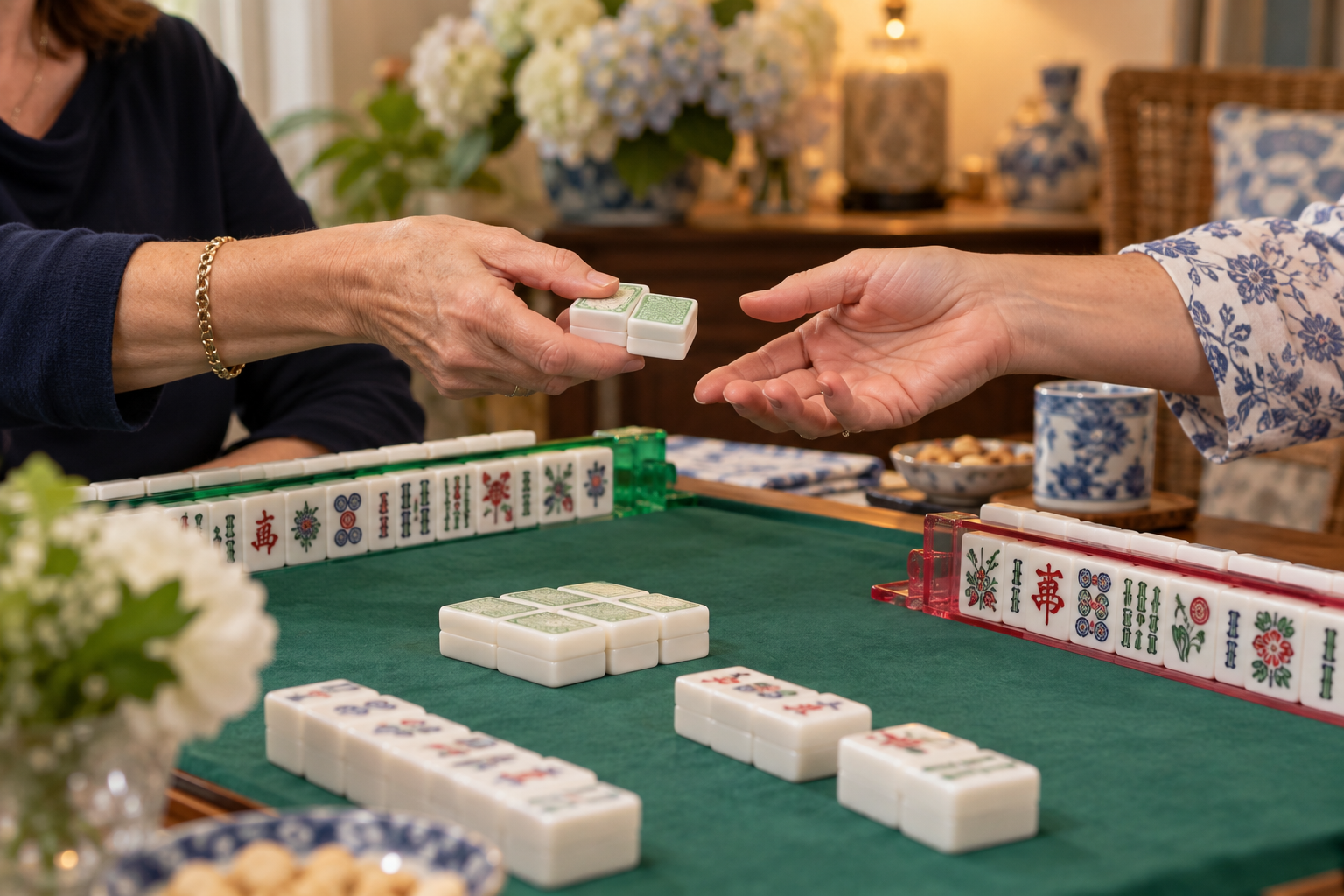
- The organized tile-passing phase before normal play. Players pass three tiles in prescribed directions to improve their racks.
- Right, across, left
- The directions used during the first Charleston. A second Charleston reverses the order.
- Blind pass
- Passing one or more tiles without looking at the tiles received from another player, when the rules allow it.
- Courtesy pass
- An optional final exchange with the player across from you. The two players agree to pass the same number of tiles.
- Stopping the Charleston
- After the first Charleston, a player may decline a second round according to standard table procedure.
The passes are easier when you have a plan. Read how the Charleston works and then review what to pass in the Charleston.
Drawing, Calling, and Discarding
- Draw
- Taking the next available tile from the wall at the beginning of your turn.
- Discard
- Placing one unwanted tile face up in the center and clearly naming it.
- Call
- Claiming the most recent discard because it completes an allowable exposed group or completes Mah Jongg.
- Exposure
- A completed group placed face up on top of the rack after calling a discard. Exposed tiles cannot be returned to the concealed rack.
- Concealed
- Tiles hidden on the sloped part of your rack. A card hand specifically marked concealed has stricter calling rules.
- Dead hand
- A hand that can no longer legally win, usually because of an incorrect exposure, too many or too few tiles, or an impossible pattern.
- Picking ahead
- Drawing before the previous player has discarded. Many groups discourage this because it creates confusion.
Joker Terms
- Joker exchange
- Replacing an exposed Joker with its matching natural tile during your turn, then taking the Joker into your rack.
- Redeem
- Another common word for making a Joker exchange.
- Dead Joker
- An informal term for a Joker that cannot help a hand, often because the needed positions are singles or pairs.
Joker use creates many beginner questions. Our complete Joker rules guide covers exchanges, calls, and common mistakes.
Winning and Scoring Terms
- Mah Jongg
- The declaration made when your 14 tiles exactly match a valid line on the current card.
- Self-pick
- Winning by drawing the needed tile from the wall rather than calling another player’s discard.
- Discard win
- Winning by calling the most recent discard for Mah Jongg.
- Value
- The score printed beside a card line. Table rules determine how that value is paid or recorded.
- Wall game
- A game in which the drawable tiles run out before anyone declares Mah Jongg.
Table Positions and Etiquette
- East
- The dealer and starting player for the hand.
- Dealer
- The player who begins with an extra tile and makes the first discard.
- Mispick
- Taking the wrong tile from the wall. How it is corrected may depend on when the error is noticed.
- Named discard
- A tile announced aloud when discarded so every player has a fair chance to call it.
- Table rules
- House conventions agreed on before play, such as timing, scoring, or how strictly minor errors are handled.
Frequently Confused Terms
- Hand vs. rack: your hand is the pattern you are building; your rack is the physical holder.
- Concealed tiles vs. a concealed hand: every player keeps tiles hidden, but only lines marked concealed have the special no-exposure restriction.
- Kong in American vs. other Mahjong variants: in American play it is a required four-tile group, not a separate declaration with an automatic replacement draw.
- Calling vs. declaring Mah Jongg: a call claims a discard for a legal purpose; Mah Jongg announces a complete winning hand.
Final Takeaway
You do not need to learn every term before your first game. Start with wall, rack, draw, discard, exposure, Charleston, Joker, and Mah Jongg. Once those words feel natural, the rest of the vocabulary attaches to actions you already understand. Keep this glossary nearby, ask players to name tiles clearly, and let real table experience do the memorizing for you.
One thought on “American Mahjong Terms: The Complete Beginner’s Glossary”