Siamese Mahjong Rules for Two Players
Siamese Mahjong rules give American Mahjong players a practical way to play with only two people. Instead of one rack per player, each player manages two racks and works toward two complete card hands at the same time.
This version is popular for couples, practice sessions, and small home games when you cannot fill a four-player table. Rules can vary by group, so treat this as a clear beginner framework and agree on house details before the first discard.
Quick Answer: How Siamese Mahjong Works
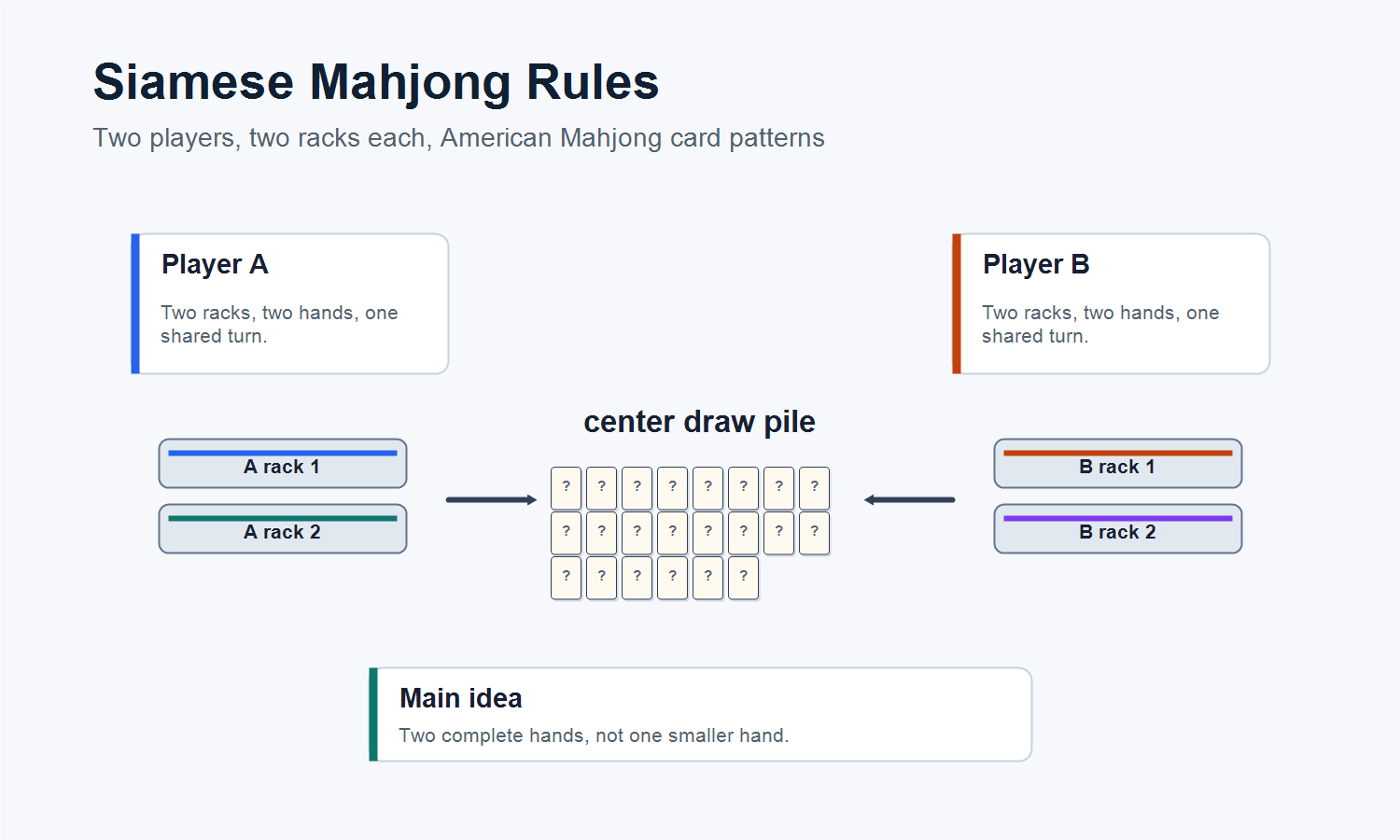
Siamese Mahjong is a two-player American Mahjong variation. Each player uses two racks, builds two separate hands from the current card, and wins only after completing both hands.
If you are brand new to the base game, read American Mahjong rules first. Siamese is easier to learn when you already understand card lines, exposures, jokers, and discards.
| Feature | Standard American Mahjong | Siamese Mahjong |
|---|---|---|
| Players | Usually 4 | 2 |
| Hands per player | 1 | 2 |
| Racks per player | 1 | 2 |
| Charleston | Usually used | Usually skipped or modified by house rule |
| How to win | Complete one legal card hand | Complete both of your hands |
What You Need
You need a standard American Mahjong set, the current card, two racks for each player, and enough table space for a face-down draw pile. A double-length rack can work if your group likes it, but two normal racks are easier for many beginners.
Because this is still American Mahjong, the joker rules and card structure matter. If jokers still feel confusing, review the American Mahjong joker rules before playing Siamese.
Siamese Mahjong Setup
Use Two Racks Per Player
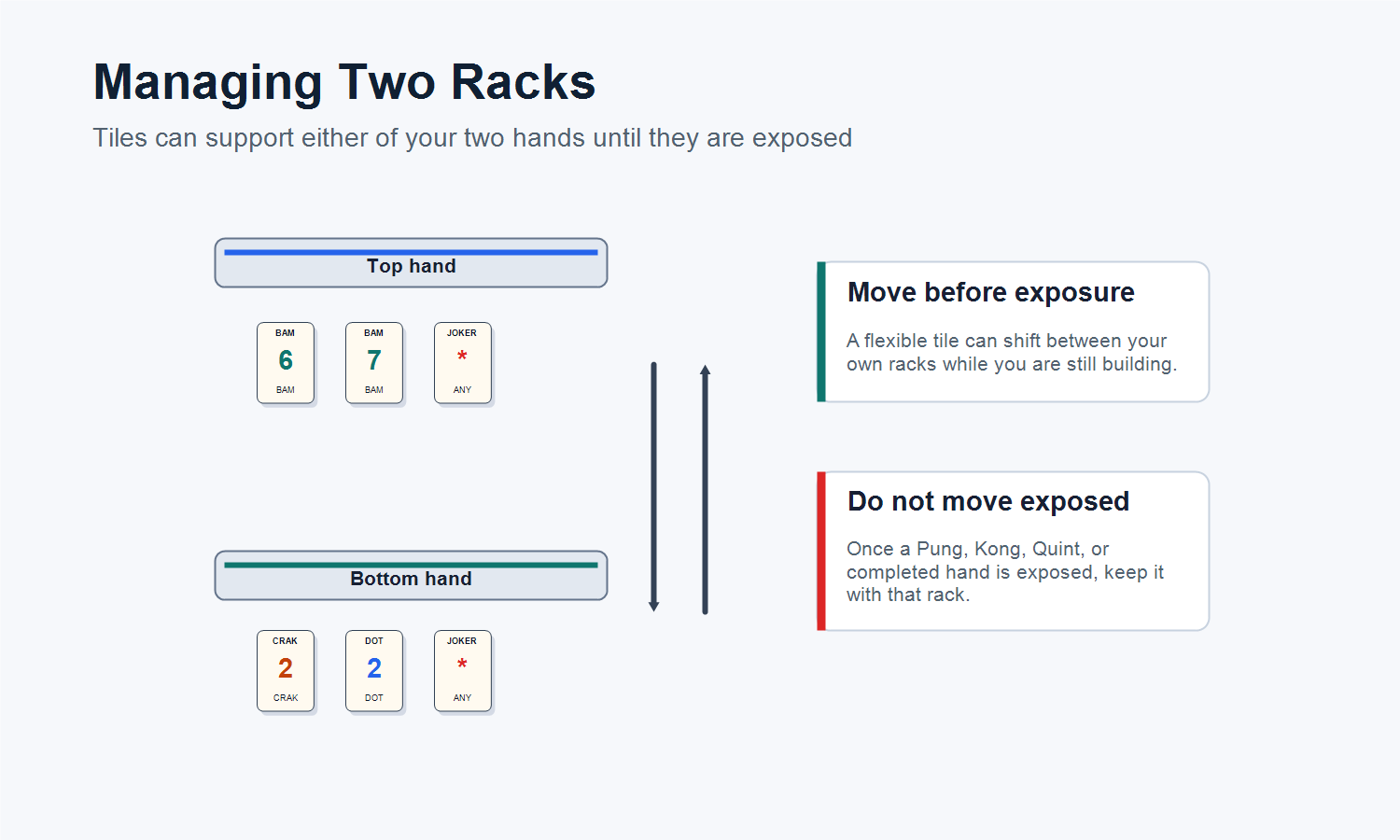
Place two racks in front of each player. Think of them as two separate hands, not one giant hand. You can study both racks together, but each rack must eventually match a legal hand from the card.
During the early game, tiles may shift between your own two racks while you are still deciding which hand each rack will become. Once tiles are exposed for a specific hand, keep that exposure with that rack.
Draw Starting Tiles From the Center
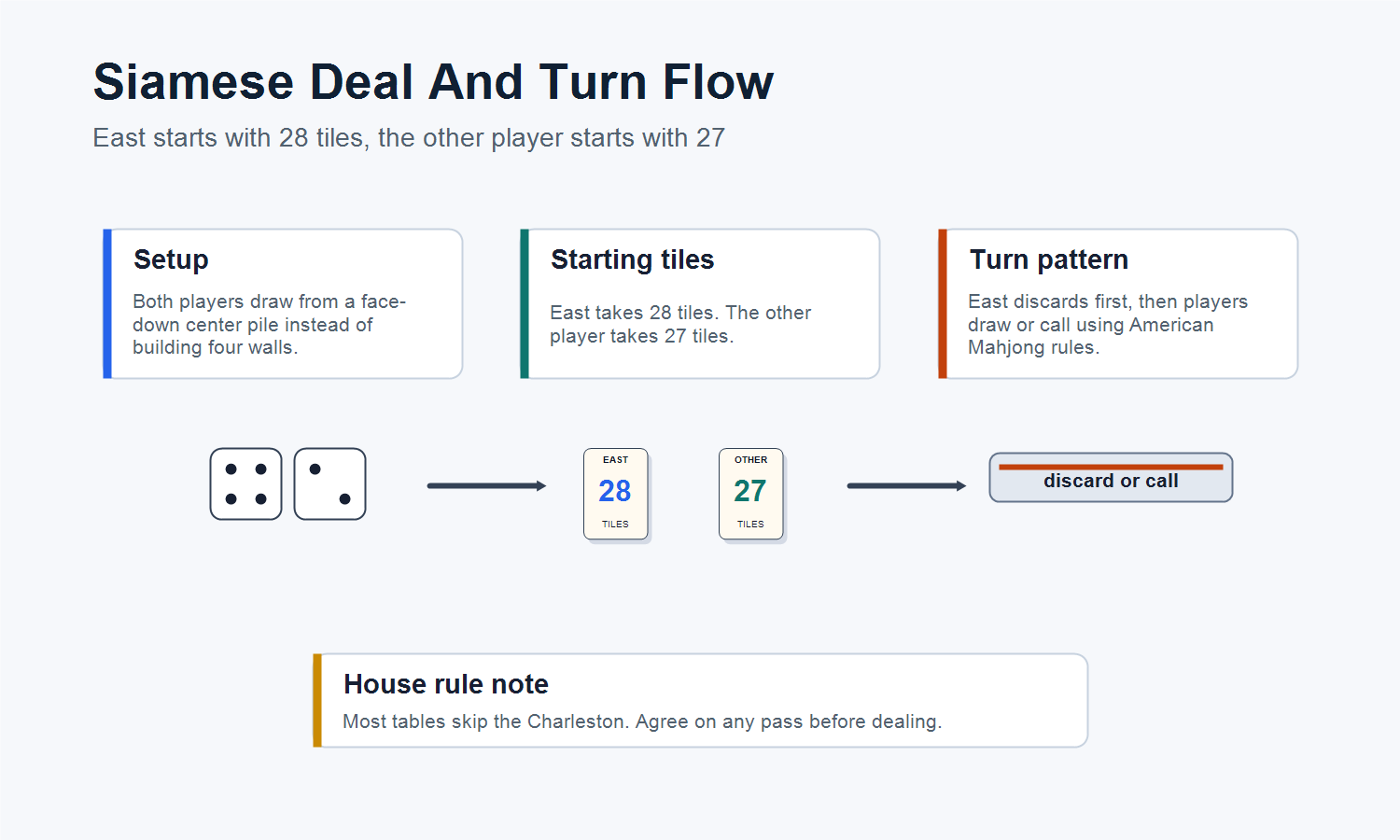
Many Siamese tables do not build four walls. Instead, players mix the tiles face down in the center of the table and draw their starting tiles from that pile.
A common starting method gives East 28 tiles and the other player 27 tiles. East has one extra tile and discards first. Some groups adjust the first draw routine, so settle this before the game starts.
Decide Your Charleston Rule
Many Siamese Mahjong players skip the Charleston because each player already has a large tile pool spread across two racks. Other groups use a short custom pass to create movement at the start.
There is no reason to argue mid-game. Decide before dealing whether your table is using no Charleston, a short pass, or another local routine. For standard four-player passing, see the Charleston in Mahjong.
How a Turn Works
East discards first from either rack. The other player may draw from the center pile or call the discard for a legal exposure, using the same basic American Mahjong calling logic.
After drawing, a player discards one tile. Play continues back and forth until one player completes both hands or the available tiles run out.
The tricky part is deciding which rack should receive a new tile. A tile that looks useless for your top rack may be valuable for your bottom rack, especially when one hand is still flexible.
How to Win in Siamese Mahjong
The goal is not to complete one rack. In most Siamese rules, you must complete both of your hands to win the round.
Some groups allow a player to declare Mahjong on one rack before the second rack is finished. That can matter when a completed hand uses exposed jokers or when a tile can only be claimed as a winning tile. Other groups prefer players to wait until both hands are complete. Agree first.
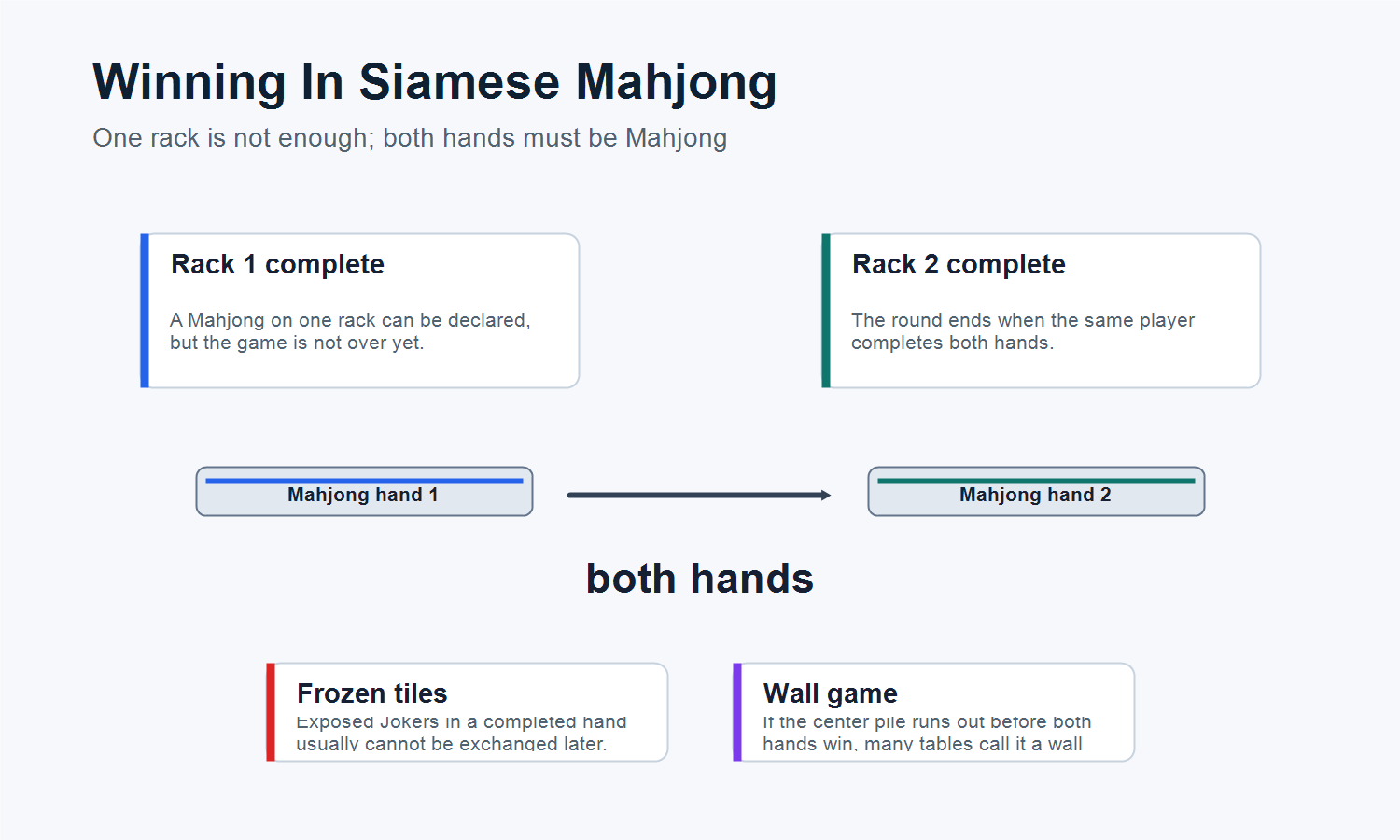
Once a completed hand is exposed, many tables freeze the tiles in that hand. That means jokers in that completed hand may no longer be exchanged. This is one of the house-rule points worth saying out loud before play begins.
Jokers in Siamese Mahjong
Jokers usually behave like they do in regular American Mahjong. They can help complete Pungs, Kongs, Quints, Sextets, and other allowed combinations, but they cannot stand in for singles or pairs under standard American rules.
The extra Siamese wrinkle is that you are managing two hands. A joker that does nothing for one rack may be exactly what the second rack needs. Check both racks before discarding or leaving a joker stuck in a weak plan.
Be careful with exposed jokers. If your table freezes jokers in a declared hand, calling one rack too early may reduce your flexibility on the second rack.
Choosing Hands for Siamese Mahjong
Good Siamese hand selection is about cooperation between your two racks. If both hands need the same numbers, same suit, and same scarce tiles, you may spend the whole game competing with yourself.
Try pairing one more flexible hand with one more specific hand. For example, one rack might chase a number-based line while the other keeps a broader suit or dragon option open. For the regular version of this decision, see how to choose a hand in American Mahjong.
| Situation | Better Siamese Choice | Why It Helps |
|---|---|---|
| Both racks need the same scarce tiles | Change one rack to a different section or suit | You avoid blocking your own progress. |
| One rack is strong, one is vague | Protect the strong rack and keep the weak rack flexible | The weak rack can absorb awkward draws. |
| You draw a joker | Check both racks before placing it | The second rack may have the stronger joker use. |
| You want to expose early | Ask what it reveals about both hands | Your opponent reads your whole table, not just one rack. |
Common Siamese Mahjong Mistakes
Beginners often understand the rules faster than they manage the two-rack strategy. The game asks you to think like two players sharing one brain.
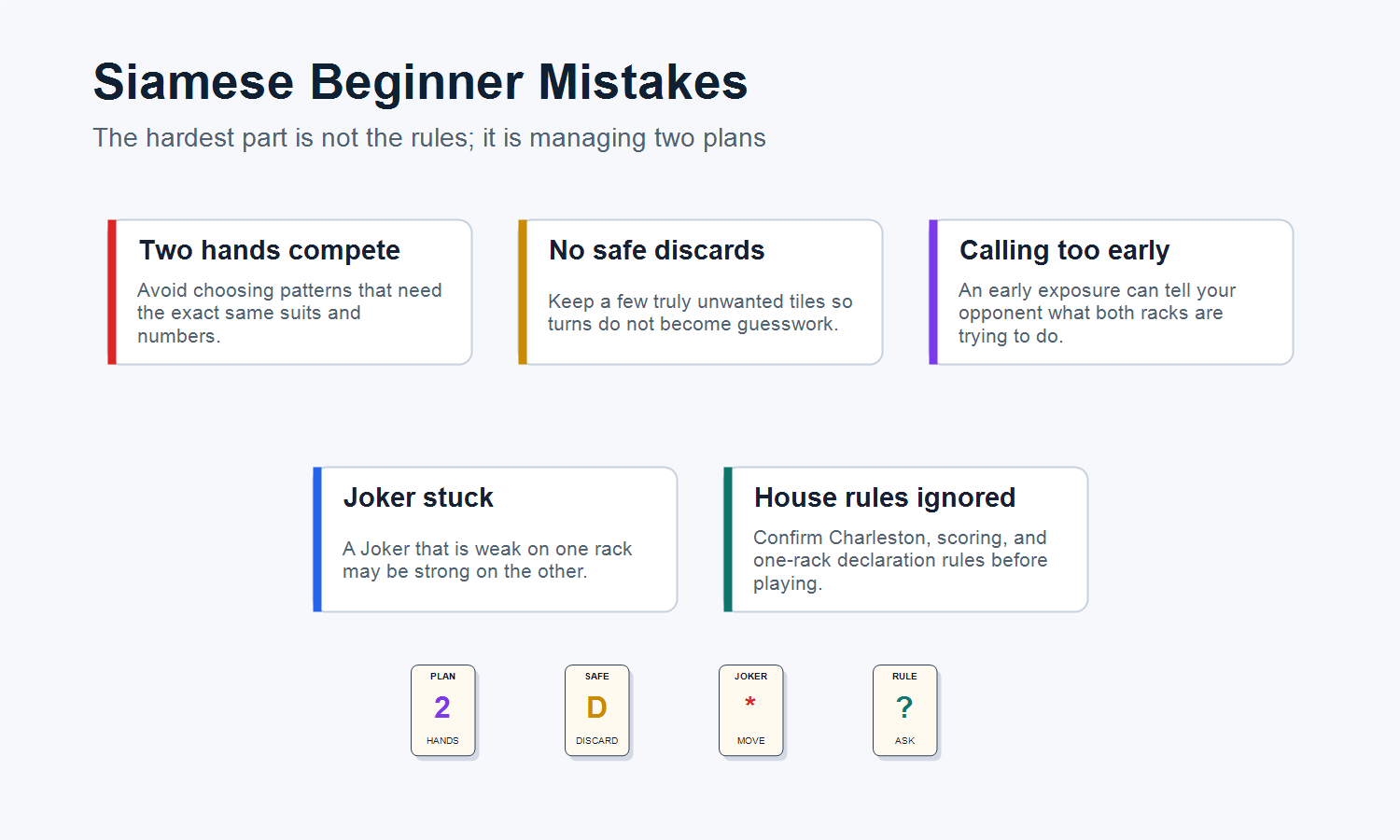
- Choosing two card lines that need the same tiles.
- Calling too early and revealing both of your plans.
- Forgetting that an exposed set belongs to one rack.
- Discarding before checking whether the other rack needs that tile.
- Playing without agreeing on scoring and one-rack declarations.
- Using four-player habits, especially the Charleston, without adapting them.
Scoring and Dead Hand Rules
Siamese scoring is one of the least standardized parts of the game. Some home tables score both completed card hands and add them together. Others use a simplified amount for the round, especially in casual practice games.
The important thing is to write down the house rule before the first deal. Also decide what happens if one rack is exposed incorrectly or no longer matches a legal card hand. For the regular American concept, review dead hands in American Mahjong.
When Siamese Is the Right Game
Siamese Mahjong is a strong choice when two people want real American Mahjong practice without waiting for a full table. It is also useful for learning the card because you must evaluate many hand possibilities at once.
If you have three players instead of two, use the separate guide to play American Mahjong with three players. Three-player Mahjong solves a different problem and should not be treated as the same variant.
FAQ
Is Siamese Mahjong the same as American Mahjong?
It is a two-player variation of American Mahjong. It still uses American card hands and jokers, but the setup, number of racks, and winning condition are different.
How many racks do you need for Siamese Mahjong?
Each player usually needs two racks, so the table needs four racks total. Some players use double-length racks, but two normal racks per player are easier to separate visually.
Do you use the Charleston in Siamese Mahjong?
Many groups skip it. Because each player already controls two racks, the opening hand has more information and flexibility. Some tables use a short custom pass, so ask before dealing.
Can you move tiles between your two racks?
Many players allow movement between your own racks while you are still building. Once tiles are exposed for a rack, that exposure should stay with that hand.
Do you have to win both hands?
In most Siamese Mahjong rules, yes. A single Mahjong hand may be declared under some house rules, but the round usually ends only when one player completes both hands.
Is Siamese Mahjong good for beginners?
It is best for beginners who already know the basics of American Mahjong. Absolute beginners may find two racks overwhelming at first, but it becomes useful practice once the card starts to make sense.