Japanese Riichi Mahjong Rules for Beginners
Japanese Riichi Mahjong rules can feel strict at first because a complete hand is not always enough. To win, you usually need a legal hand shape, at least one yaku, and no furiten problem blocking your claim.
This guide is for U.S. beginners who want the practical version before memorizing a long scoring chart. Riichi rules are more standardized than many casual Mahjong styles, but local clubs, apps, and tournaments may still use small rule differences.
Quick Answer: How Riichi Mahjong Works
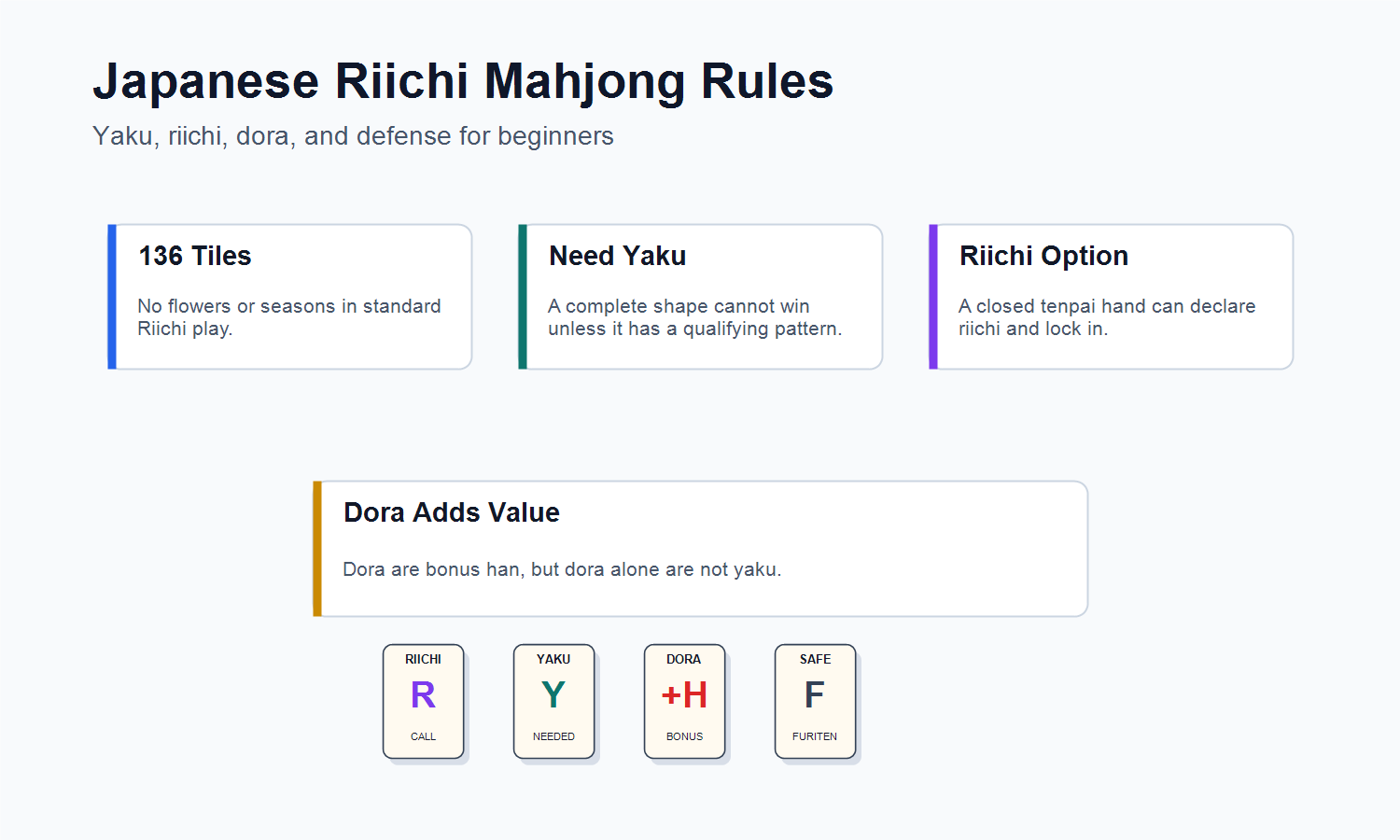
Riichi Mahjong is a Japanese Mahjong style played by four players with 136 tiles. Players draw, discard, and claim tiles to complete a hand, but the hand must include at least one yaku to win.
A yaku is a qualifying pattern. Dora are bonus tiles that add value after you already have a valid hand, but dora alone do not make the hand legal. Furiten can stop you from winning on another player’s discard if your own discards include a tile that completes your hand.
| Term | Plain-English Meaning | Beginner Reminder |
|---|---|---|
| Yaku | A pattern that qualifies your hand to win | No yaku usually means no win. |
| Riichi | A declaration from a closed ready hand | It can be your yaku, but it locks your hand. |
| Dora | Bonus tiles that add value | Dora are not yaku by themselves. |
| Furiten | A discard-related restriction on ron | You may be unable to win from a discard. |
| Ron | Winning on another player’s discard | Furiten matters most when you want to ron. |
| Tsumo | Winning by self-draw | A furiten hand may still win by tsumo. |
What Makes Riichi Different?
Riichi Mahjong is more rules-driven than many casual Chinese Mahjong styles. It uses no flowers, no American-style jokers, and no yearly card. The game focuses on yaku, tile efficiency, defensive discards, and scoring with han and fu.
If you are coming from American Mahjong, the biggest shift is that the card is gone. If you are coming from Chinese Mahjong, the biggest shift is the yaku requirement and furiten rule.
For a broader comparison of Mahjong variants, see American Mahjong vs Chinese Mahjong. For Hong Kong-style fan scoring, read Hong Kong Mahjong rules.
Riichi Tile Set and Setup
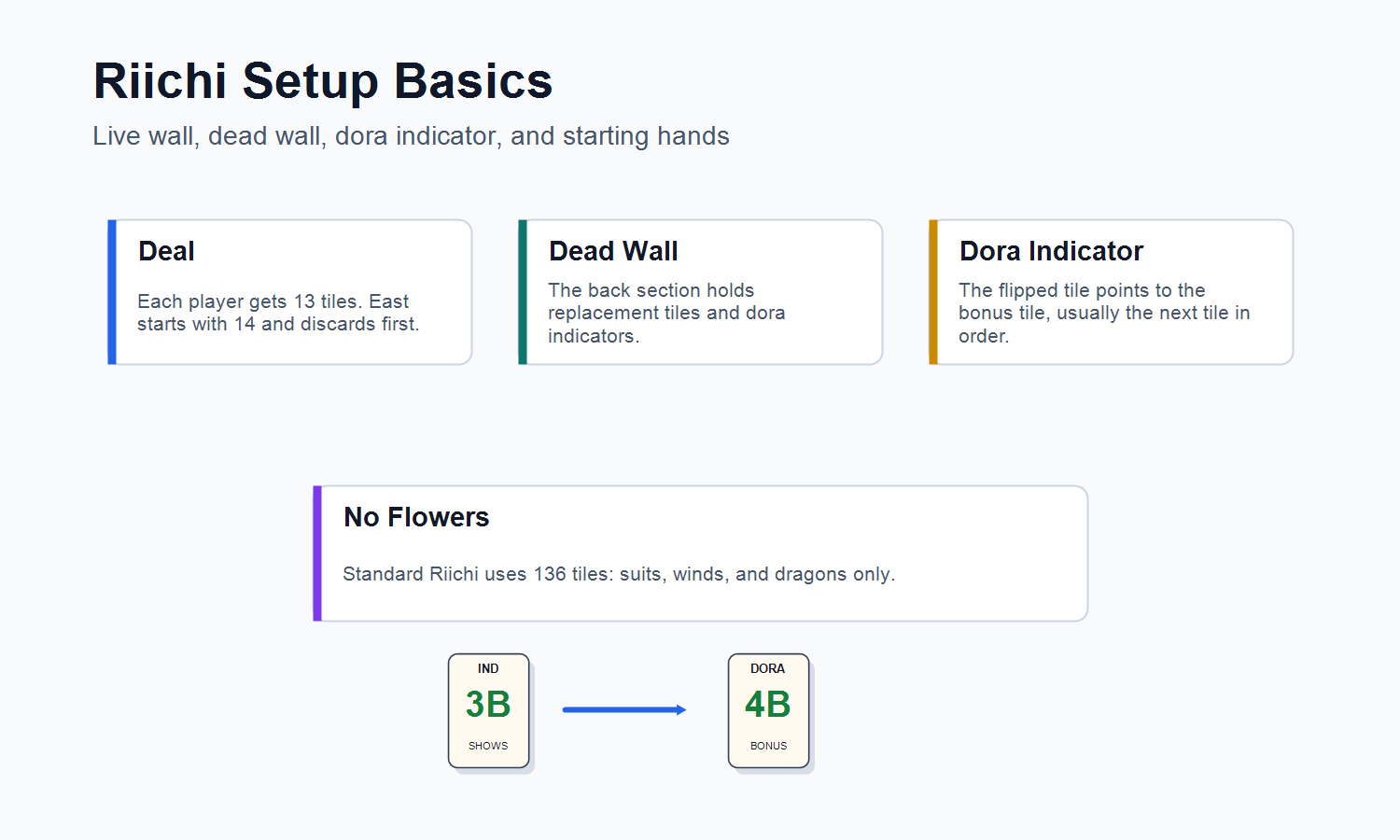
Standard Riichi Mahjong uses 136 tiles: Dots, Bams, Craks, winds, and dragons. Flowers and seasons are not used in normal Riichi play.
Each player starts with 13 tiles. East starts with 14 and makes the first discard. The wall includes a dead wall, which contains replacement tiles and dora indicators.
If you need help with basic tile names first, use this Mahjong tiles guide. The set details differ, but the suit and honor names will help you read Riichi examples.
Turn Flow: Draw, Discard, Call, Repeat
Most turns follow a simple pattern: draw one tile, choose what to keep, and discard one tile. Other players may call that discard for chi, pon, kan, or ron if the rules allow it.
A closed hand keeps more scoring options open. Calling tiles can make a hand faster, but it may remove yaku options such as riichi, menzen tsumo, or iipeikou.
Chi
Chi is a sequence call, such as 3-4-5 in one suit. You can usually chi only from the player to your left.
Pon
Pon is a triplet call using another player’s discard. A pon can create useful yaku when it involves dragons, your seat wind, or the round wind.
Kan
Kan is a four-of-a-kind. It creates replacement draw handling and can reveal additional dora indicators. Kan rules are worth learning slowly because they affect both hand value and table risk.
The Yaku Requirement
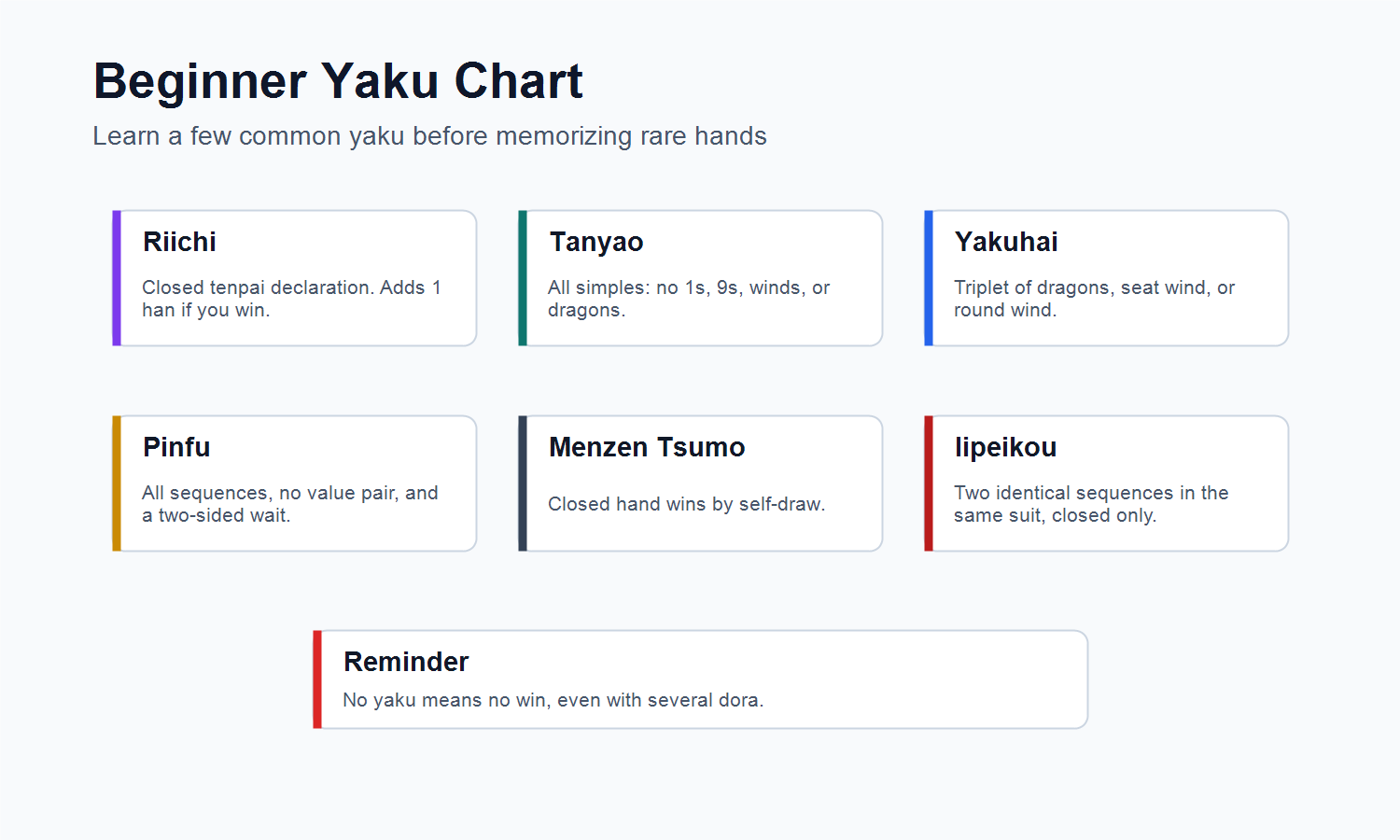
The core beginner rule is simple: you need at least one yaku to win. A hand can be beautifully complete and still be illegal if it has no yaku.
Do not try to memorize every yaku at once. Learn a small set of common yaku first, then add more as your tile reading improves.
| Beginner Yaku | Basic Idea | Closed or Open? |
|---|---|---|
| Riichi | Declare when your closed hand is ready | Closed only |
| Tanyao | All simples, with no 1s, 9s, winds, or dragons | Often open or closed, depending on table rules |
| Yakuhai | Triplet of dragons, seat wind, or round wind | Open or closed |
| Pinfu | All sequences, no value pair, two-sided wait | Closed in standard scoring |
| Menzen tsumo | Closed hand wins by self-draw | Closed only |
| Iipeikou | Two identical sequences in the same suit | Closed only |
For general hand-shape practice, this guide to Mahjong winning hands is useful. Riichi then adds the extra question: “Which yaku makes this hand legal?”
What Riichi Means
Riichi is a declaration made when your closed hand is in tenpai, meaning it is waiting on one or more tiles to win. You place a 1,000-point stick and announce riichi.
After declaring riichi, your hand is mostly locked. You usually discard drawn tiles unless the draw completes your win or allows a legal closed kan. That commitment is why riichi is powerful but not automatic.
When Riichi Helps
- You have a closed hand with a good wait.
- You need a simple yaku to make the hand legal.
- Your hand has dora or other value worth pushing.
- The table situation rewards pressure on opponents.
When Riichi Can Be Risky
- Your wait is poor, such as a single tile with few copies left.
- An opponent is clearly dangerous.
- Your hand is cheap and the 1,000-point stick matters.
- You need flexibility for defense.
Dora and Furiten
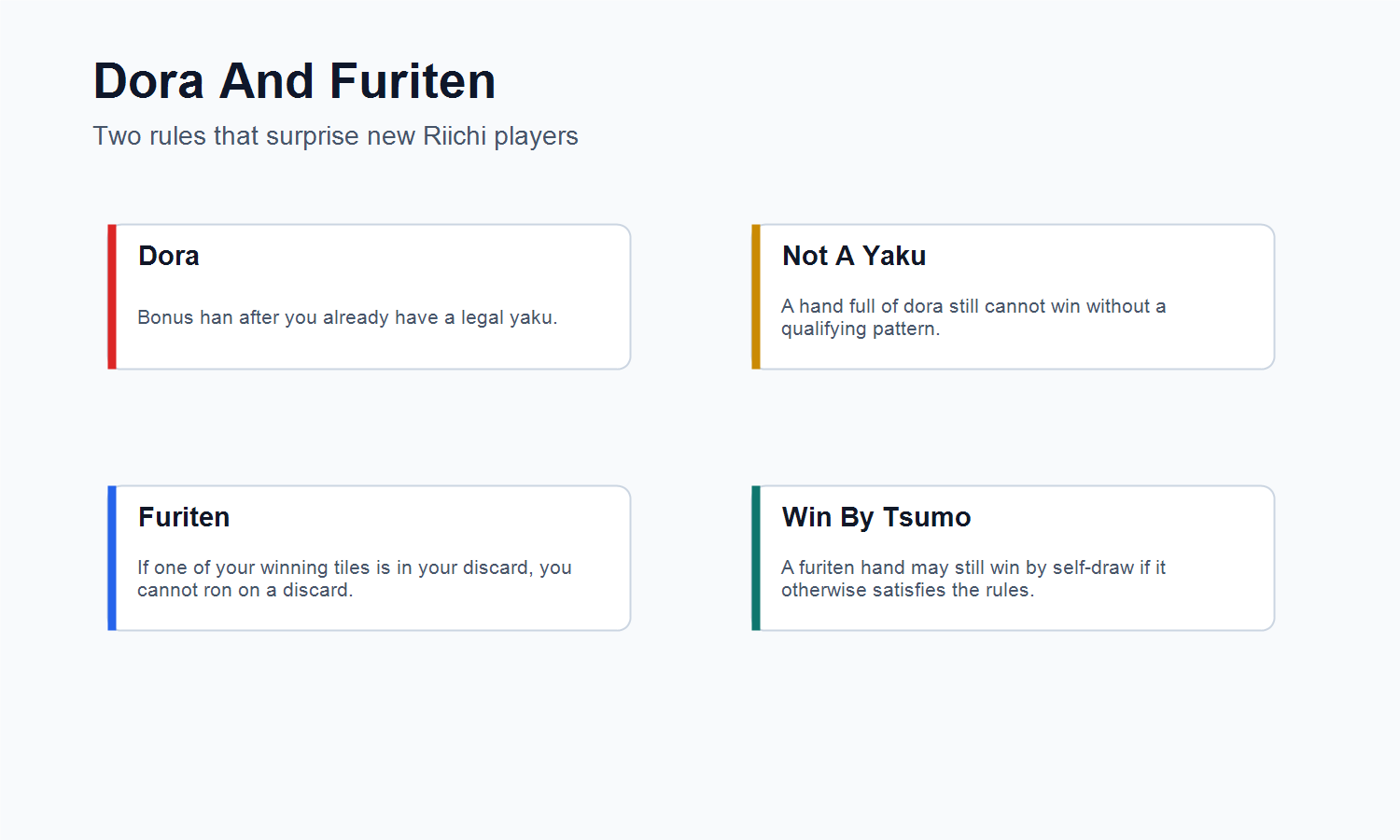
Dora are bonus tiles. They increase your hand’s value, but they do not count as yaku. A hand with three dora and no yaku is still not a legal winning hand in normal Riichi play.
Furiten is the rule that often trips up new players. If your own discard pile includes a tile that could complete your current hand, you cannot win by ron on another player’s discard. You may still be able to win by tsumo.
Simple Furiten Example
Suppose your hand can win on 3 Bamboo or 6 Bamboo. If you previously discarded a 3 Bamboo, you are furiten for that wait. You cannot ron another player’s 6 Bamboo either, because your current winning shape includes a tile already in your discard.
This is why Riichi defense starts with discard awareness. Your own discard pile is not just history; it affects what you are allowed to claim.
Scoring Basics: Han, Fu, and Points
Riichi scoring uses han and fu. Han come from yaku and dora. Fu are smaller hand-value details such as waits, triplets, pair value, and winning method.
Beginners do not need to calculate every payment in their first session. Learn to identify yaku, count obvious han, and use a scoring table or app until the math feels familiar.
| Scoring Piece | What It Does | Beginner Habit |
|---|---|---|
| Yaku han | Qualifies and increases the hand value | Name your yaku before counting bonuses. |
| Dora han | Adds bonus value | Count only after the hand has yaku. |
| Fu | Adjusts point calculation | Use a chart at first. |
| Dealer status | Changes payment | Dealer wins and dealer payments are larger. |
| Ron or tsumo | Changes who pays | Ron is paid by the discarder; tsumo is paid by all opponents. |
Riichi vs Hong Kong Mahjong
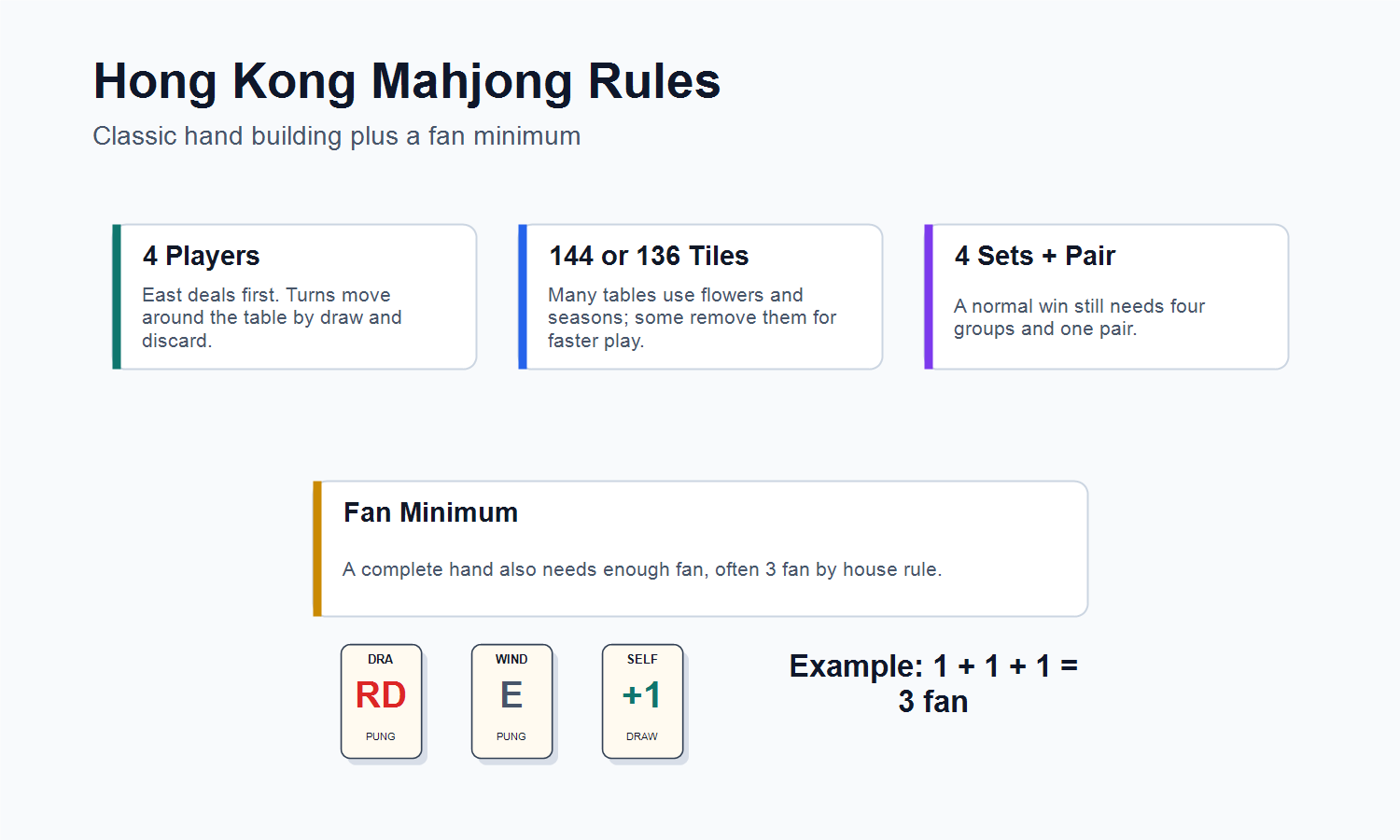
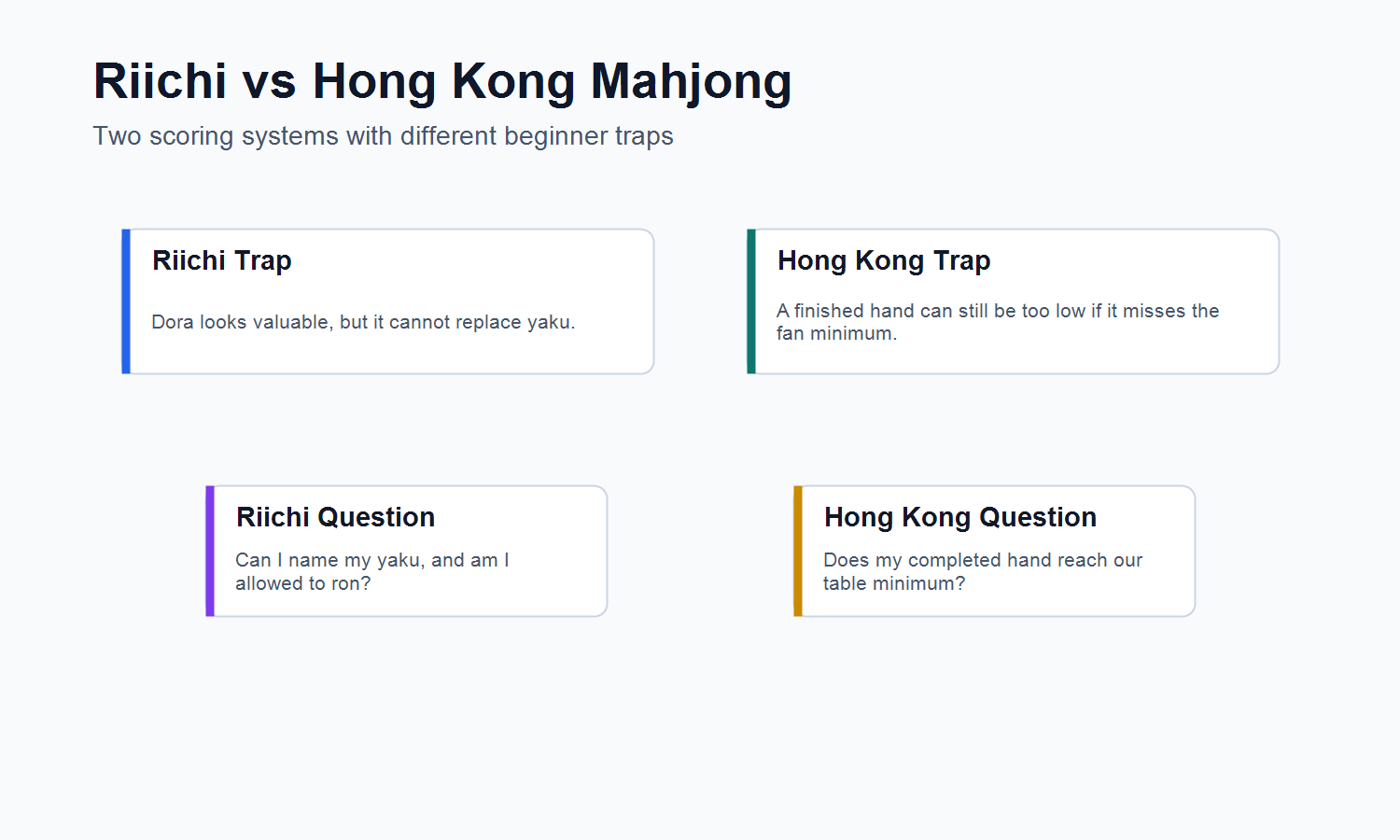
Riichi and Hong Kong Mahjong both punish incomplete rules knowledge, but in different ways. Riichi beginners most often forget yaku, misunderstand dora, or miss furiten. Hong Kong beginners often complete a hand that does not meet the fan minimum.
Common Beginner Mistakes
- Trying to win with no yaku: A complete shape is not enough.
- Thinking dora are yaku: Dora add value but do not qualify the hand.
- Missing furiten: Your own discards can block ron.
- Opening the hand too early: Calling can remove closed-hand yaku options.
- Declaring riichi on a bad wait: Riichi creates pressure, but it also removes flexibility.
- Ignoring safe tiles: Defense matters because one dangerous discard can pay another player’s hand.
For broader table habits, see common Mahjong mistakes new players make. If you want a fast rules refresher before sitting down, use this Mahjong cheat sheet.
FAQ
Is Riichi Mahjong the same as Japanese Mahjong?
In most English-language contexts, Japanese Mahjong refers to Riichi Mahjong. It is the dominant modern Japanese ruleset used in clubs, apps, and many tournaments.
Do you always need a yaku?
Yes, in normal Riichi play you need at least one yaku to win. Some rare situations and local rules can be unusual, but beginners should treat “no yaku, no win” as a core rule.
Can dora be my only yaku?
No. Dora are bonus value after the hand is already legal. They do not qualify the hand by themselves.
Can I win if I am furiten?
You generally cannot win by ron while furiten, but you may still win by tsumo if your hand is otherwise legal.
Should beginners call tiles often?
Call only when you know your yaku. Opening your hand can make it faster, but it may remove riichi and other closed-hand options.
What should I learn first in Riichi?
Learn tile names, basic hand shape, a few common yaku, the difference between ron and tsumo, how dora work, and the furiten rule.
Final Takeaway
Riichi Mahjong is easiest to learn when you stop treating it as just “four sets and a pair.” That shape matters, but it needs a yaku, and your discard history can affect whether you may win.
Start with a small yaku list, count dora only after the hand is legal, and check furiten before calling ron. Those three habits will prevent many beginner mistakes.