When Should You Break a Pair in Mahjong?
Knowing when to break a pair in Mahjong is one of those small decisions that separates random discards from real strategy. A pair feels safe because it looks useful, but not every pair deserves to stay. Sometimes splitting it opens a faster hand, protects you from a bad exposure, or lets you follow the hand you are actually closest to completing.
For American players, the answer depends heavily on the rule set. In American Mahjong, a pair printed on the card is often hard to replace because jokers usually cannot stand in for pairs. In many Chinese-style games, a pair may become the eyes of the hand, but it can also block a better sequence. This guide explains how to decide without overthinking every tile.
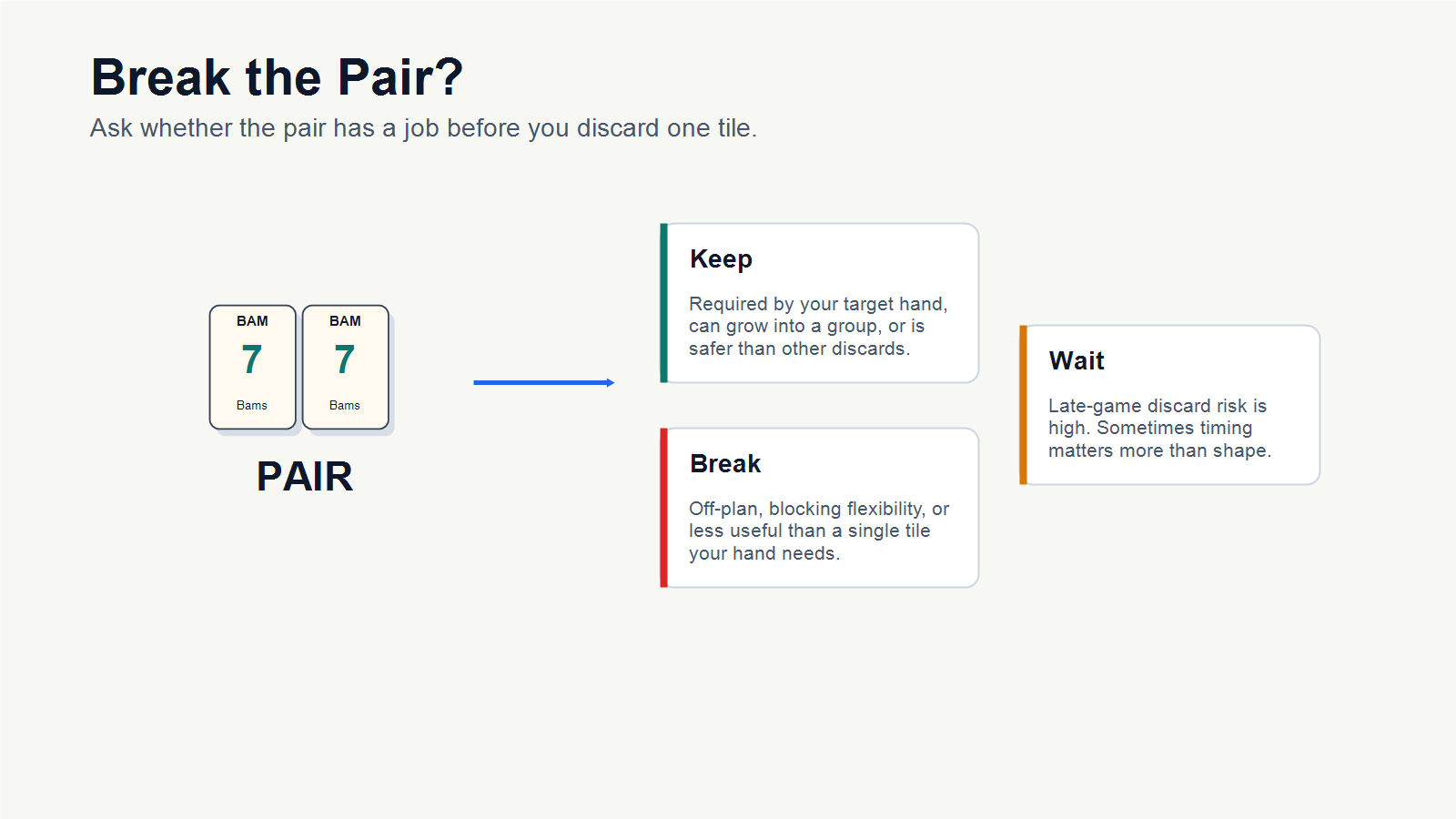
What Does It Mean to Break a Pair?
To break a pair means to discard one tile from two identical tiles in your hand. For example, if you have two 7 bams and discard one of them, you have broken that pair.
That can feel wrong at first. New players often treat every pair as precious. But Mahjong is not about collecting matching tiles in general; it is about completing a legal hand under the rules your table is using.
If you are still learning how pairs fit into winning shapes, review this guide to Mahjong winning hands. It explains the classic four-sets-and-a-pair idea as well as how American Mahjong card patterns work.
The Main Question: Is This Pair Part of Your Plan?
The best pair decision starts with a blunt question: does this pair support the hand you are actually trying to make? If it does, keep it. If it does not, the pair may only be taking up space.
In American Mahjong, this usually means checking the current card. If the line you are playing needs a pair of flowers, a pair of flowers is important. If your line needs a kong of 7 craks and your pair is two 1 dots, that pair may be a passenger.
| Pair Situation | Usually Keep It? | Why It Matters |
|---|---|---|
| The pair is printed in your American Mahjong hand line | Yes | Pairs are exact and often cannot be replaced with jokers. |
| The pair can become a pung or kong you need | Usually | One more matching tile may make the pair much stronger. |
| The pair does not match any likely hand | Often no | Keeping it can slow down a more realistic plan. |
| The pair is dangerous to discard late | Maybe | Sometimes the safer move is to keep it and discard something lower risk. |
| The pair blocks a flexible sequence | Often no | In many traditional games, a tile may be more useful as part of a chow. |
When You Should Keep a Pair
Some pairs are worth protecting. The trick is knowing whether the pair has a real job. A useful pair is not just two matching tiles; it is two matching tiles that point toward a legal hand.
Keep it when the card requires it
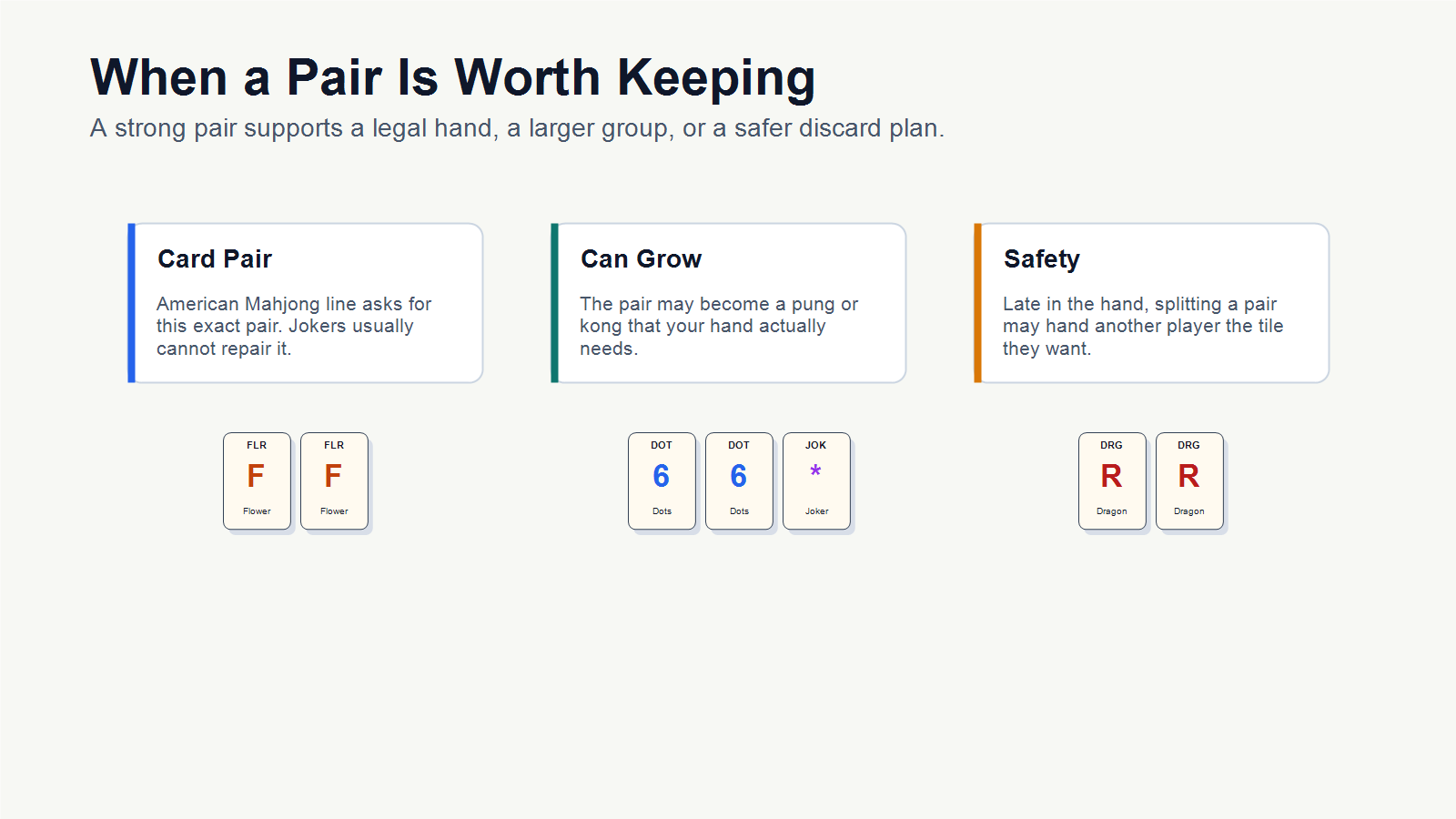
In American Mahjong, if your target line calls for a pair, that pair is usually valuable. This is especially true because jokers generally cannot be used for singles or pairs in common American play.
That means a natural pair can be harder to build than a kong. A kong can often use a joker. A pair usually has to be made from the real tile. If you are new to the card and exposures, this American Mahjong rules guide gives useful background.
Keep it when it has room to grow
A pair can become a pung or kong if more copies are still available. Early in the game, two matching tiles in a useful suit may be a strong starting point. This is more convincing if your hand has other tiles that support the same direction.
For example, two 6 bams are more useful if your rack also has 4 bams, 5 bams, 7 bams, or a card line that likes even numbers. The pair belongs to a wider plan.
Keep it when discarding it would help another player
Late in the hand, breaking a pair can become risky. If several players are clearly chasing one suit or one number family, discarding a matching tile may feed a call or a winning hand.
This does not mean you should freeze. It means the same pair can change value as the game develops. A pair that was easy to break on turn three may be dangerous on turn twelve.
When You Should Break a Pair
Breaking a pair is not a failure. It is often the cleanest way to improve your hand. The goal is to discard the tile that helps your future the least.
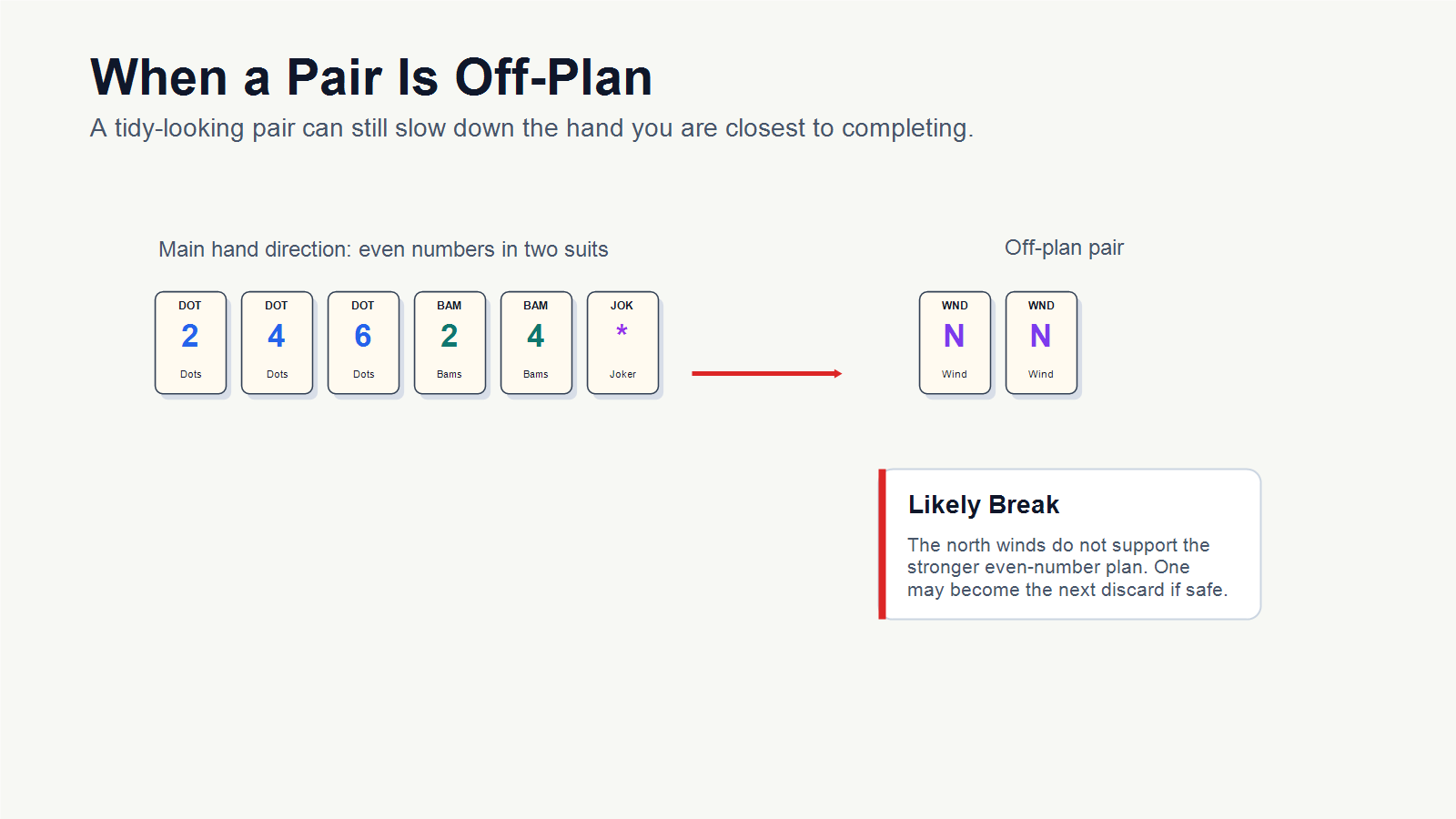
Break it when the pair is off-plan
If a pair does not appear in any realistic hand you are considering, it may be safe to split. Beginners often keep a random pair because it looks organized, while discarding a single tile that actually supports the hand.
That is backwards. A lonely pair is not better than a useful single. In American Mahjong, a single flower, dragon, or number may be more important than a pair if the card line requires it.
Break it when it blocks flexibility
In many traditional Mahjong variants, a pair can sometimes block a better structure. If you have 5-5-6-7 in one suit, one of the 5s may work better as part of a 5-6-7 chow while the other becomes less important.
Rules vary by style. Chows are central in many Chinese-style games, but they are not used the same way in modern American Mahjong. If you are comparing styles, this Chinese Mahjong beginner guide helps separate those habits.
Break it when a stronger hand is forming
Sometimes your starting plan fades and a new plan appears. Maybe you picked up jokers, flowers, or matching numbers that point to a better American Mahjong line. If the old pair does not fit the new plan, holding it out of habit can cost you turns.
This is where flexible players gain ground. They are not loyal to their first idea. They keep checking which hand is becoming more realistic.
A Simple Pair Decision Checklist
Use this checklist before you break a pair. It is short enough to use during a real game.
- Does my target hand need this exact pair? If yes, be careful before splitting it.
- Can this pair become a useful pung or kong? If yes, count how many copies may still be available.
- Does another hand use one tile from the pair better? If yes, splitting may improve flexibility.
- Is this tile dangerous to discard right now? If yes, timing matters.
- Am I keeping it only because it looks tidy? If yes, it may be time to let one go.
| Game Stage | Pair Strategy | Beginner Move |
|---|---|---|
| Opening hand | Stay flexible | Keep useful pairs, but do not protect every pair automatically. |
| After the Charleston | Choose your direction | Compare your pairs against two or three likely card lines. |
| Middle game | Commit more clearly | Break pairs that do not support your main plan or backup plan. |
| Late game | Think about safety | Do not break a pair if the discard is likely to complete another player’s hand. |
American Mahjong Example: Keep or Break?
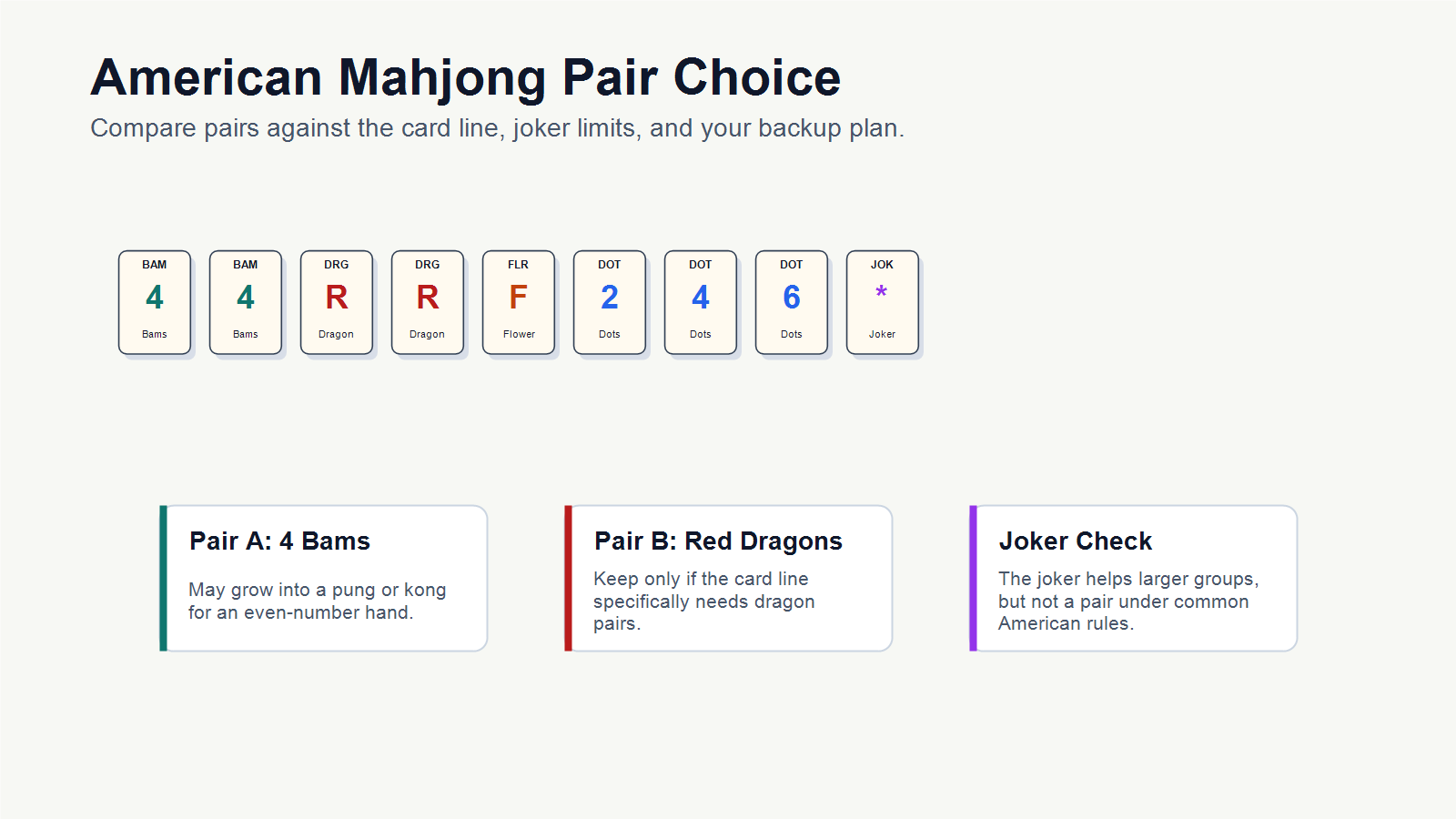
Imagine your rack has two 4 bams, two red dragons, one flower, a joker, and several even-numbered tiles. You are considering one card line built around even numbers and another that uses dragons.
The pair of 4 bams may be stronger if the even-number hand can turn them into a pung or kong. The red dragon pair may be stronger if the card line specifically asks for a pair of dragons. The flower may look lonely, but it could still be required by the line.
The point is not that one tile type is always better. The point is to judge the pair by the line you can realistically complete. If the 4 bams support two possible lines and the red dragons support only one weak plan, you may break the dragon pair first.
Traditional Mahjong Example: Pair or Sequence?
In a Chinese-style hand, imagine you hold 4-5-5-6 in dots. The two 5 dots form a pair, but 4-5-6 is also a useful sequence. If you already have another pair elsewhere, breaking the 5-dot pair may help you complete a faster hand.
This is why habits from one Mahjong style do not always transfer neatly to another. American Mahjong is card-driven. Many traditional variants are shape-driven and score-driven. If the tiles themselves still feel hard to read, review the Mahjong tiles guide before working on discard strategy.
Common Mistakes When Breaking Pairs
- Breaking a required American Mahjong pair: If your card line needs that exact pair, replacing it may be harder than you think.
- Keeping every pair too long: Too many pairs can make your hand look promising while blocking progress.
- Ignoring joker limits: A joker may help a pung or kong, but it usually cannot repair a broken pair.
- Discarding dangerous tiles late: A pair tile that was safe early may become risky after several exposures.
- Changing plans without checking the card: In American Mahjong, a better-looking hand is not useful unless it matches a legal line.
- Copying advice across rule sets: Pair decisions differ between American, Chinese, Riichi, Hong Kong, and house-rule games.
How to Practice Pair Decisions
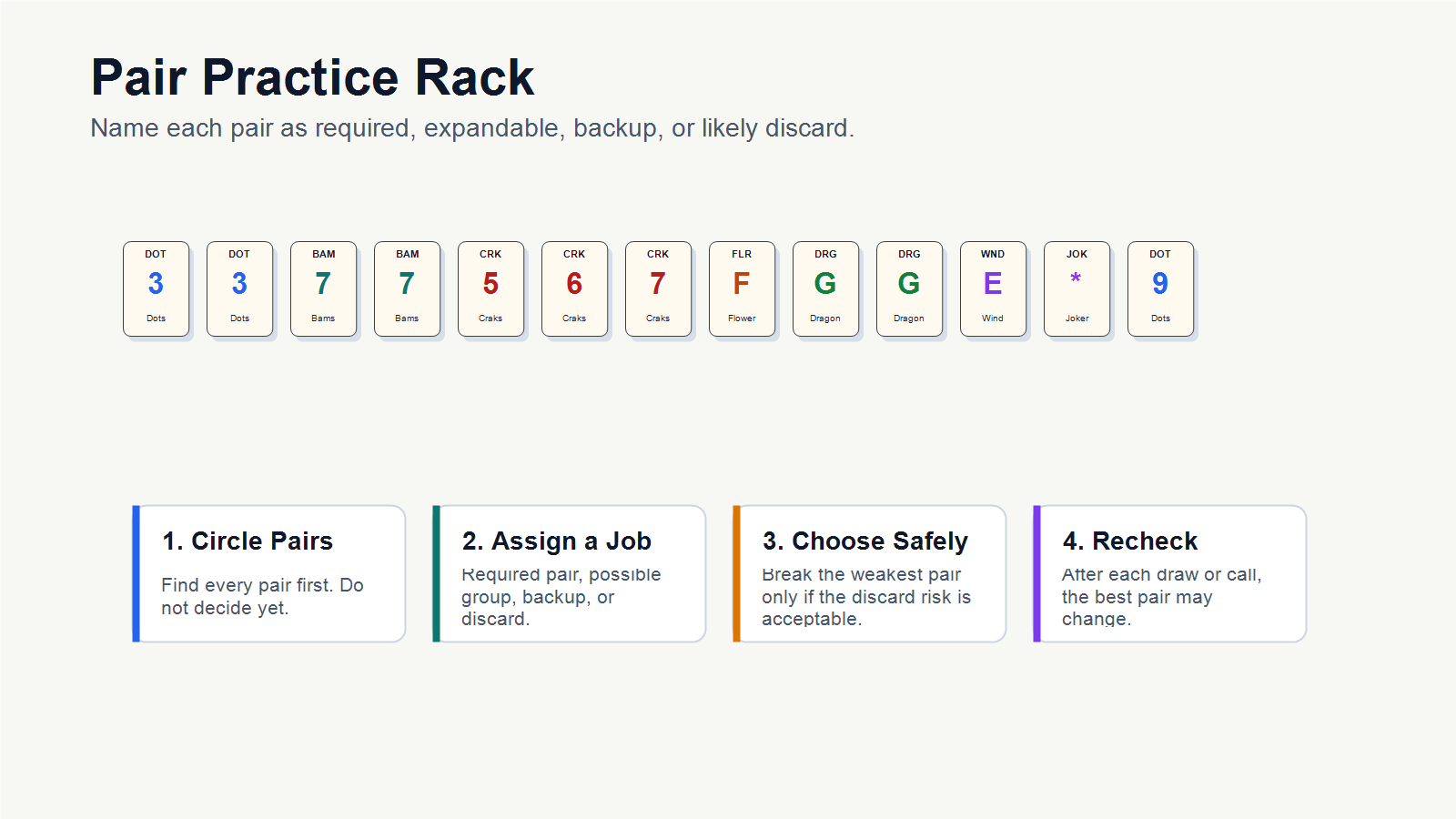
You can practice this without playing a full game. Deal yourself 13 tiles, sort them, and circle every pair. Then ask what each pair is doing.
For American Mahjong practice, put the current card beside your rack and choose two possible lines. Mark which pairs are required, which can become larger groups, and which are off-plan. Then choose one discard and say the reason out loud.
For traditional Mahjong practice, compare pairs against possible sequences and pungs. Notice when a pair is your only pair and when it is simply extra weight.
FAQ About Breaking a Pair in Mahjong
Is it bad to break a pair in Mahjong?
No. Breaking a pair is bad only when the pair is important to your winning plan or when the discard is dangerous. If the pair is off-plan, splitting it may be the smart move.
Should beginners keep all pairs?
No. Beginners should notice all pairs, but they should not protect all of them. Keep pairs that match your hand direction. Reconsider pairs that do not support a legal hand.
Can I call a discard to make a pair in American Mahjong?
In common American Mahjong play, you generally cannot call a discard just to make a pair unless that tile completes Mahjong. Table rules can vary, so confirm before play starts.
Can jokers replace a broken pair?
Usually no in American Mahjong. Jokers are commonly used in groups of three or more, not singles or pairs. That is why breaking a required pair can be costly.
When is a pair most valuable?
A pair is most valuable when it is required by your target hand, hard to replace, or likely to grow into a group you need. It is less valuable when it has no connection to your main plan.
Do pair decisions change late in the game?
Yes. Early pair decisions are mostly about hand building. Late pair decisions are also about safety because your discard may help another player call or win.
Final Takeaway
The right time to break a pair in Mahjong is when the pair no longer serves your hand. Do not keep a pair just because it looks complete. Keep it because it is required, flexible, or safer than the alternatives.
Good Mahjong strategy is rarely about one dramatic discard. It is about making small choices that keep your hand legal, flexible, and realistic. Pair decisions are a perfect place to practice that habit.