Mahjong Cheat Sheet for Beginner Players
A Mahjong cheat sheet is most useful when it helps you make faster decisions at the table, not when it tries to explain every rule in the game. If you are a new player in the United States, keep this page nearby for the basics: tile groups, turn flow, common hand shapes, American Mahjong card reminders, and beginner mistakes to avoid.
Different Mahjong styles use different rules, scoring systems, and table habits. This guide focuses on the ideas beginners ask for most often, with special notes where American Mahjong differs from traditional Chinese-style play.
Before You Start: Know Which Mahjong You Are Playing
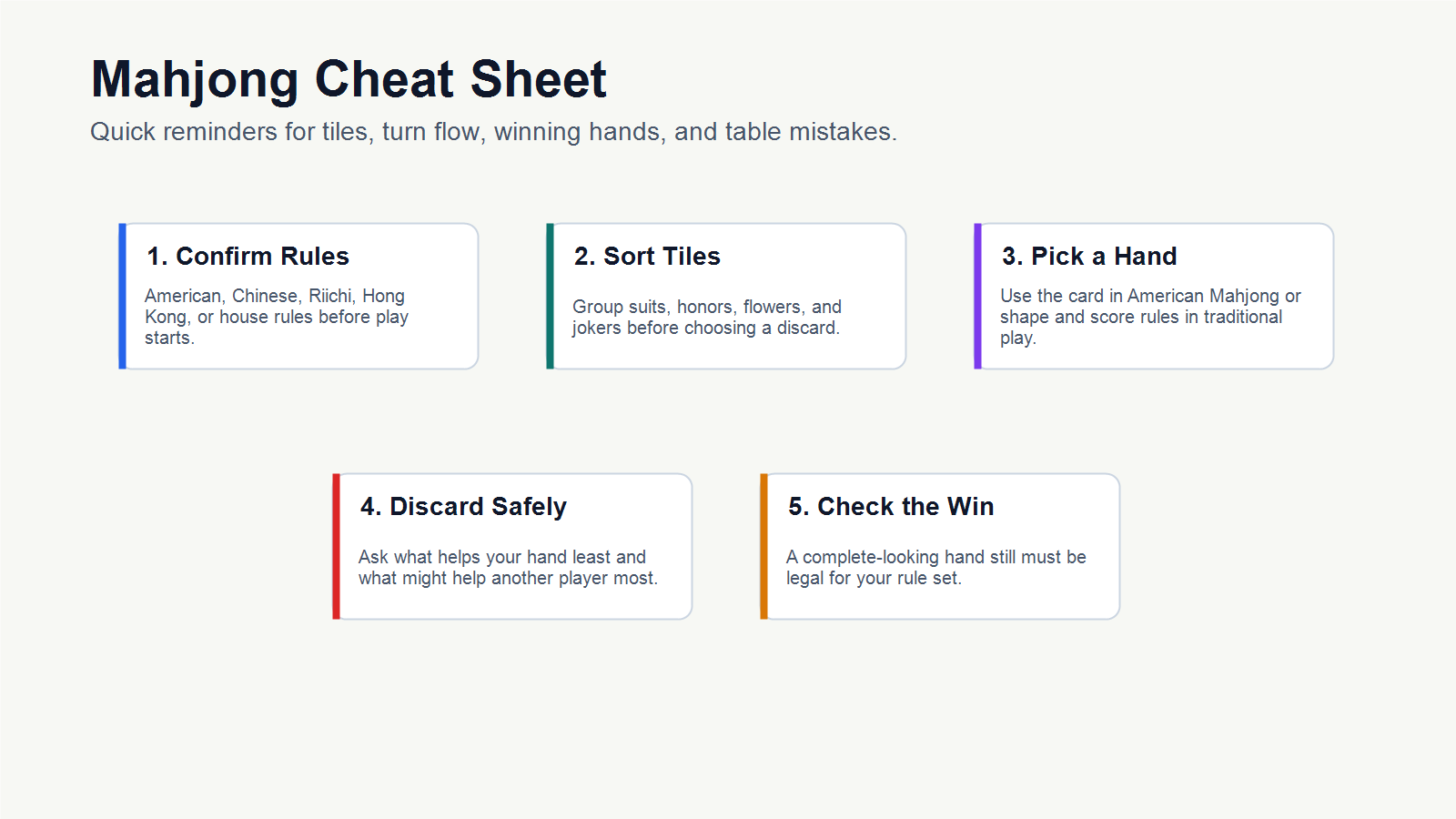
The first rule on any cheat sheet should be this: confirm the version before the tiles are shuffled. American Mahjong, Chinese Mahjong, Hong Kong Mahjong, Riichi, and house-rule games can all look similar at first glance, but they do not use the same winning hands or scoring rules.
If you are brand new, start with What is Mahjong? for the big picture. Then use this page as a table-side reference.
| Question | Why It Matters | Ask Before Play |
|---|---|---|
| Which rule set are we using? | Winning hands and calls vary. | American, Chinese, Riichi, Hong Kong, or house rules? |
| Are jokers used? | Jokers change hand building. | Common in American Mahjong, not standard in many traditional sets. |
| Is there a minimum score? | A complete hand may still not qualify. | Ask how the table declares a valid win. |
| Can exposed hands win? | Some hands must stay concealed. | Check the card or table rules before calling. |
Tile Groups at a Glance
Most beginners get faster once the tile groups feel familiar. If the names still slow you down, review the full Mahjong tiles guide.
| Tile Group | What It Includes | Beginner Reminder |
|---|---|---|
| Dots | Numbers 1-9 | One of the three numbered suits. |
| Bams | Numbers 1-9 | The 1 Bam often has a bird design. |
| Craks | Numbers 1-9 | Also called characters in some groups. |
| Winds | East, South, West, North | Honor tiles, not numbered suit tiles. |
| Dragons | Red, Green, White | Often used in special hands and scoring. |
| Flowers | Flower tiles | Important in American Mahjong hand patterns. |
| Jokers | American Mahjong wild tiles | Usually for groups of three or more, not singles or pairs. |
Basic Turn Flow Cheat Sheet
Exact procedures vary, but the rhythm of Mahjong is easy to remember: draw or claim, improve your hand, discard. Stay aware of what other players expose and discard.
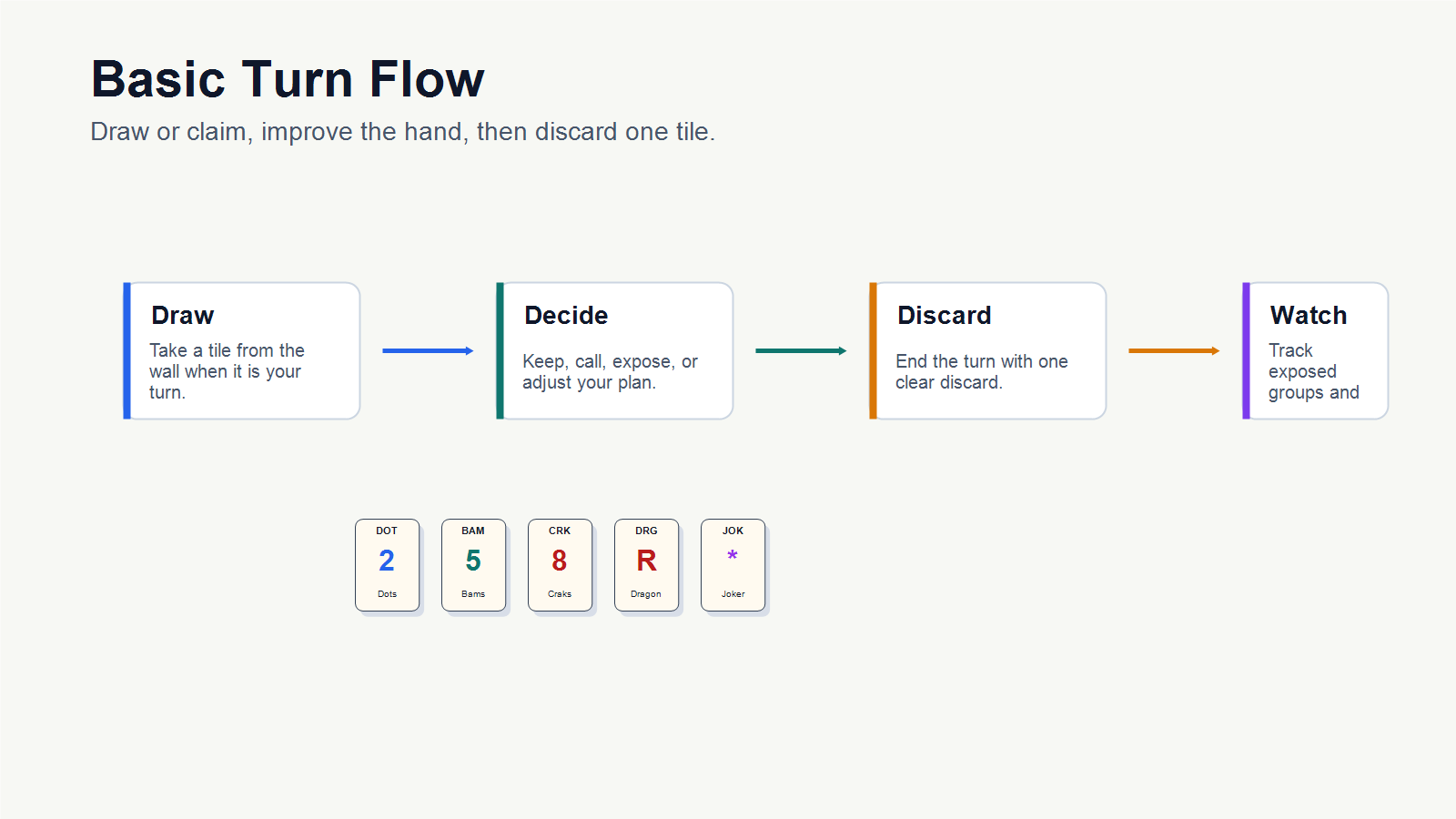
- Draw: Take a tile from the wall when it is your turn.
- Claim: In some situations, take another player’s discard to complete an allowed group.
- Expose: Put called tiles face up when the rules require it.
- Discard: End your turn by discarding one tile.
- Declare Mahjong: Announce a legal winning hand when completed.
Winning Hand Reminders
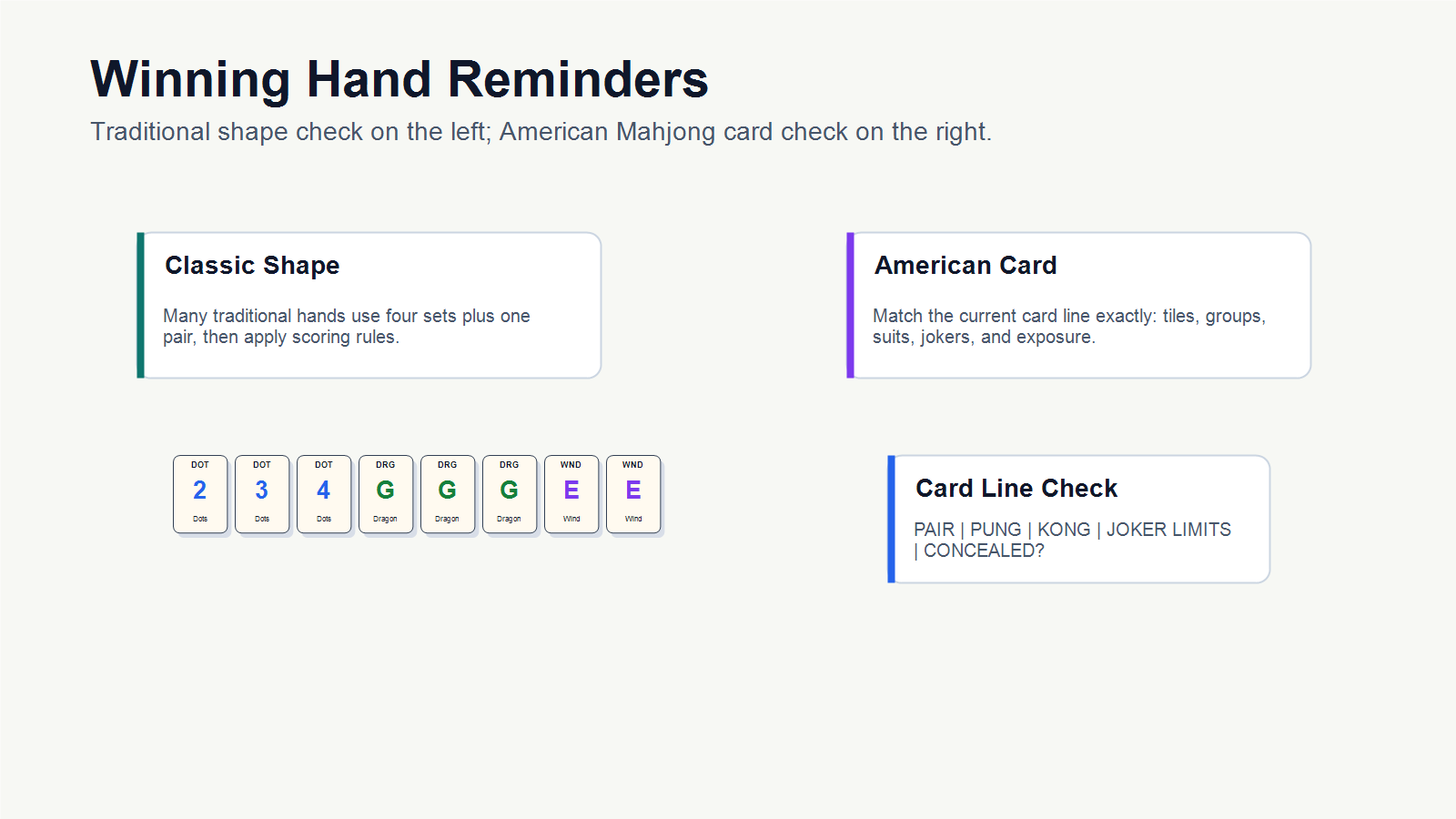
Many traditional Mahjong variants use a common shape: four complete sets and one pair. The sets may be sequences, triplets, or four-of-a-kind groups depending on the rules. The pair is the final matching pair.
American Mahjong is different. You are trying to match a specific line on the current card. If you need a deeper explanation, use this guide to Mahjong winning hands.
| Term | Simple Meaning | Important Note |
|---|---|---|
| Pair | Two identical tiles | American Mahjong pairs usually need natural tiles, not jokers. |
| Chow | Three suited tiles in sequence | Used in many traditional games, not the same way in American Mahjong. |
| Pung | Three identical tiles | Can often be exposed if the rule set allows it. |
| Kong | Four identical tiles | May involve replacement-tile rules in some variants. |
| Concealed | Not exposed during play | Calling too early can make a concealed hand dead. |
American Mahjong Card Reminders
For U.S. players, the most useful cheat sheet is often the one that prevents card mistakes. In American Mahjong, the annual card tells you what hands are legal that year. Do not rely on an old example as a current winning hand.
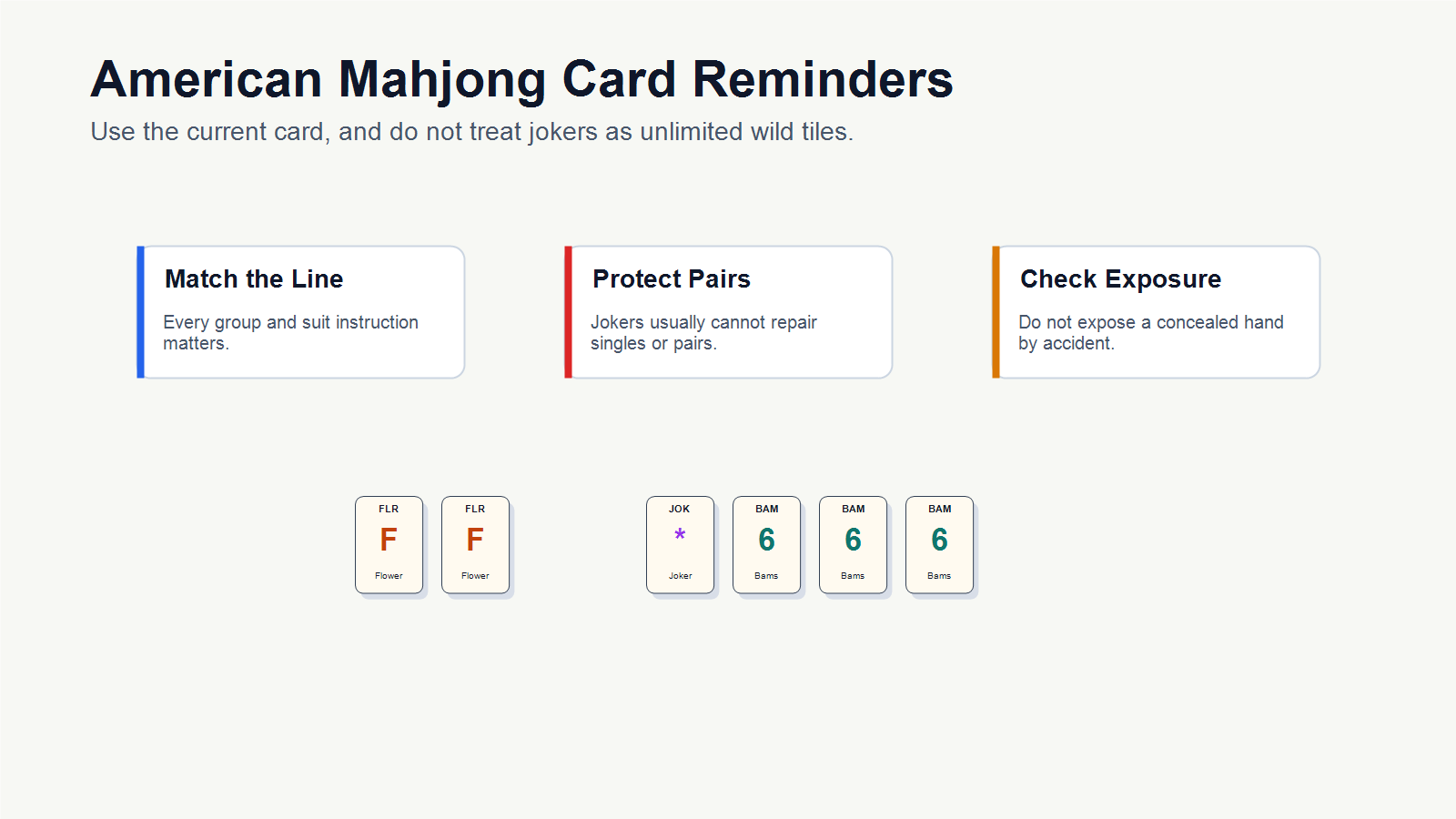
- Match the whole line: Number, suit color, tile group, and exposure status all matter.
- Watch pairs: Jokers generally cannot replace singles or pairs in common American play.
- Use jokers carefully: They usually help pungs, kongs, quints, and larger groups.
- Check concealed hands: Do not expose a hand marked concealed unless the winning-tile rule allows it.
- Keep backup plans: Early tiles may support two possible lines. Stay flexible until one plan becomes stronger.
American Mahjong Quick Sheet
If you are playing American Mahjong, keep these table reminders close. They cover the most common beginner questions: Charleston order, joker limits, hand choice, scoring, calls, and late-game defense.

| Topic | Quick Reminder | Full Guide |
|---|---|---|
| Charleston | First pass order is usually right, across, left. The second Charleston may be optional. | The Charleston in Mahjong |
| What to pass | Keep flexible clues such as pairs, flowers, jokers, and strong number groups. | What to pass in the Charleston |
| Jokers | Jokers usually help grouped tiles, not pairs or singles. | Mahjong joker rules |
| Hand choice | Choose the hand your rack supports, not only the highest-point line. | How to choose a hand |
| Scoring | Start with the printed card value, then apply your table’s payout rules. | American Mahjong scoring |
| Strategy | Intermediate play means reading exposures, timing calls, and discarding with risk in mind. | American Mahjong strategy |
For full table flow, Charleston basics, and American-style reminders, see the American Mahjong rules guide.
Discard and Safety Reminders
A good discard is not simply the tile you dislike. It is the tile that helps your hand the least while giving opponents the least help.
- Sort your rack before discarding.
- Notice repeated discards in one suit or number.
- Be more careful after players expose groups.
- Do not keep every pair just because it looks neat.
- Late in the game, safety may matter more than speed.
If you are deciding whether to split a pair, read when to break a pair in Mahjong. That topic deserves its own decision process.
Common Beginner Mistakes
| Mistake | Why It Hurts | Quick Fix |
|---|---|---|
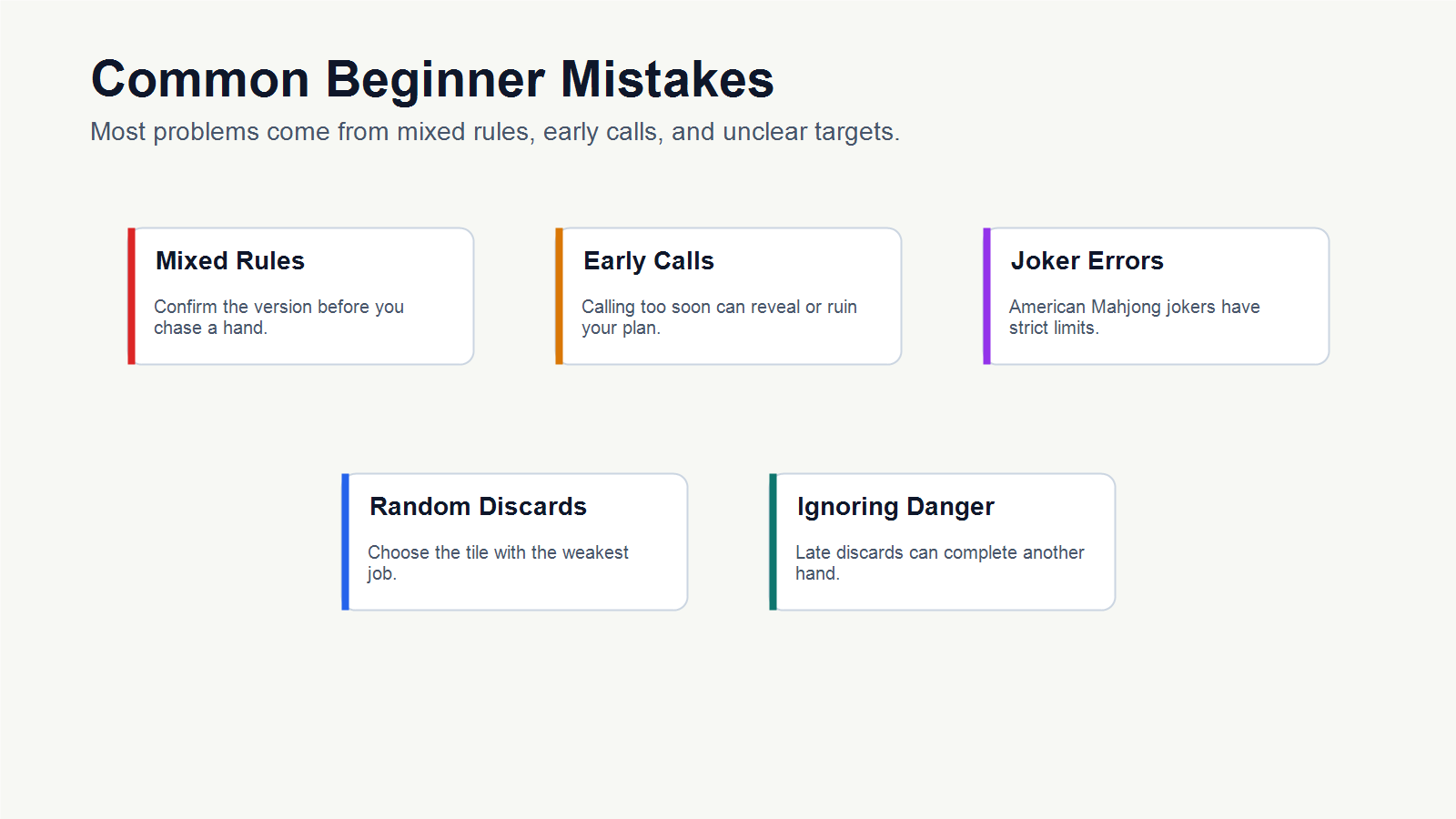
| Mixing rule sets | You may chase a hand that is not legal at your table. | Confirm the version before play starts. |
| Calling too soon | You reveal your plan and may ruin concealed options. | Check whether the call improves your actual target hand. |
| Using jokers everywhere | American Mahjong jokers have limits. | Do not use them for singles or pairs unless your table rules say otherwise. |
| Ignoring discards | You miss danger signs and tile availability. | Watch what is exposed and what keeps being thrown. |
| Over-memorizing | Memorizing terms without decisions does not help much. | Practice sorting, choosing a target, and explaining one discard. |
Mini Practice Routine
Use this quick drill before a real game. Deal yourself 13 tiles, sort them, and name two possible plans. Then choose one discard and explain why it helps the least.
For Chinese-style play, compare sequences, pungs, and the pair. For American Mahjong, compare your rack against two or three card lines. The goal is not to be perfect; it is to stop discarding randomly.
FAQ
Can I print this Mahjong cheat sheet?
Yes. It is written in short sections so you can print the page or copy the tables into a personal reference. For actual American Mahjong hands, always use the current official card at the table.
What is the most important rule for beginners?
Know the version you are playing. A hand that is legal in one style may not be legal in another.
How many tiles are in a winning hand?
Most Mahjong hands complete with 14 tiles, but replacement tiles, flowers, and special rules can affect how a hand is handled. Follow your table’s rule set.
Can beginners use a cheat sheet during play?
In casual home games, most groups are fine with beginners using a reference. In organized play, ask first.
Is American Mahjong harder than Chinese Mahjong?
It is different, not automatically harder. American Mahjong requires learning the card and joker rules, while many traditional variants focus more on hand shape and scoring.
Final Takeaway
The best Mahjong cheat sheet keeps you calm at the table. Sort your tiles, confirm the rule set, choose a realistic hand, and make each discard with a reason.