How to Choose a Hand in American Mahjong
Learning how to choose a hand in American Mahjong is less about guessing the perfect line and more about reading your rack honestly. Your tiles, jokers, pairs, flowers, and Charleston results should guide the hand you choose.
This beginner strategy guide is for U.S. players using an American Mahjong card. The card changes yearly, and local teaching styles vary, so use this as a decision process rather than a fixed list of hands to chase.
Quick Answer: Choose the Hand Your Rack Supports
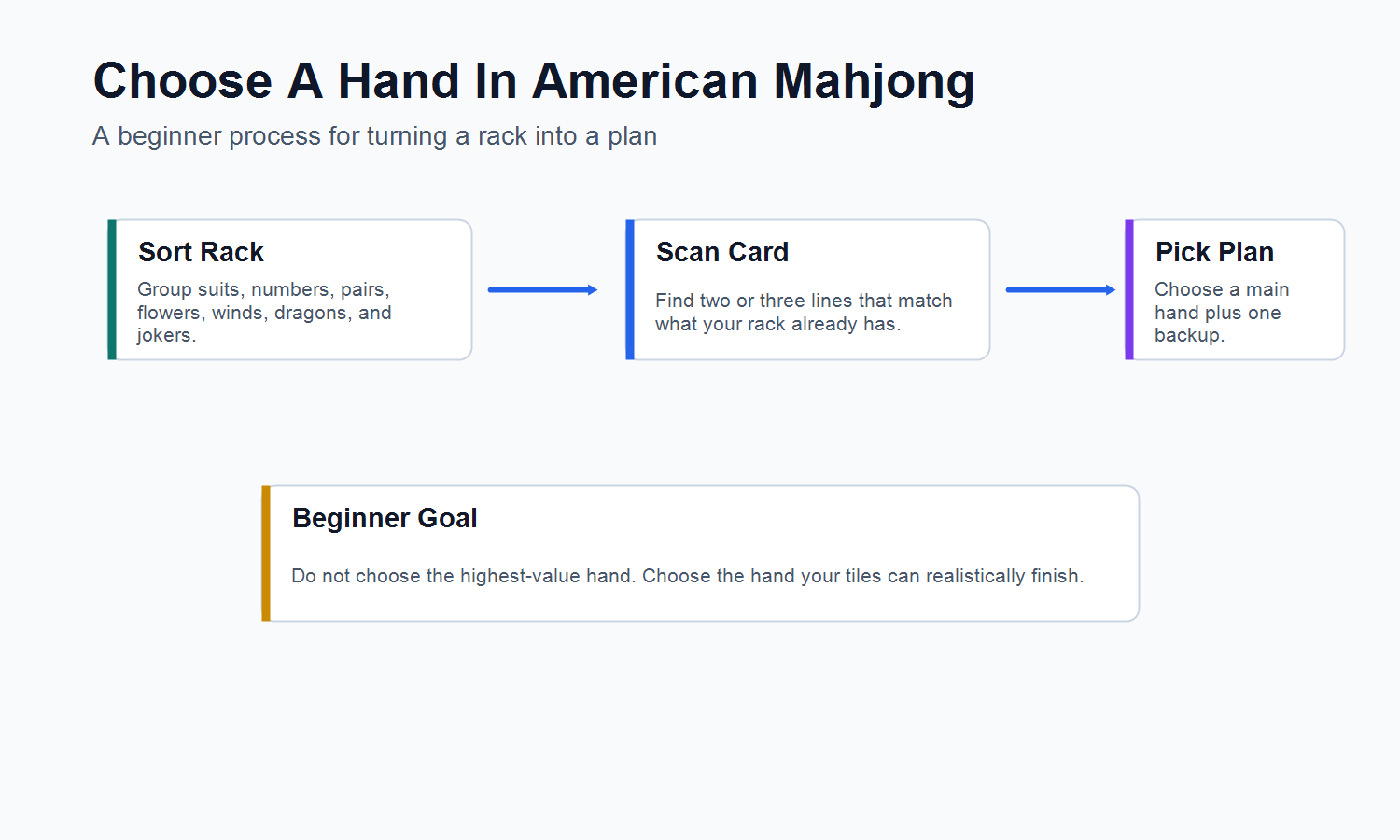
Do not start by looking for the highest point value. Start by asking what your rack already has. Strong pairs, repeated numbers, flowers, jokers, and suit clusters are the clues that point toward realistic card lines.
A good beginner hand choice usually has three qualities: it uses tiles you already own, it has at least one backup direction, and it does not depend on too many exact tiles that are hard to get.
If you need a refresher on the tile groups, use the Mahjong tiles guide before you practice this process.
Step 1: Sort Your Rack First
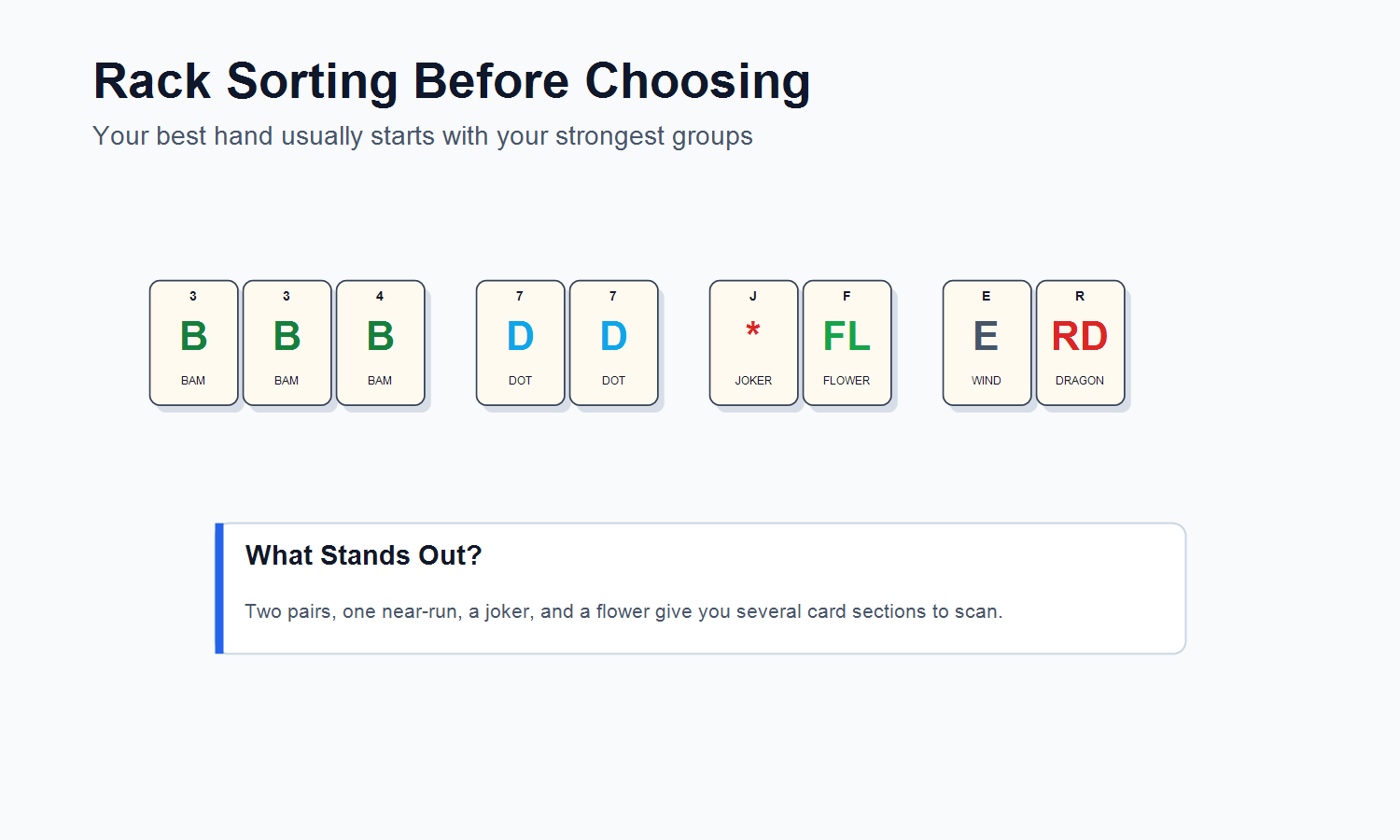
Before you scan the card, sort your tiles. Put suits together, separate winds and dragons, notice flowers, and mark pairs or near-groups. A messy rack makes every hand look equally possible, which is not helpful.
After sorting, look for the strongest clues. Two pairs may point toward pair-based hands. Several tiles of the same number may point toward like-number sections. A joker may make grouped hands more realistic.
| Rack Clue | What It Suggests | Beginner Note |
|---|---|---|
| Natural pairs | Pair-heavy lines may be possible. | Pairs are hard to rebuild, so protect useful ones. |
| Jokers | Grouped hands become easier. | Jokers help sets, but usually not pairs or singles. |
| Flowers | Many card sections may open up. | Flowers are flexible early in the hand. |
| Same number across suits | Like-number lines may be worth checking. | Look for repeated numbers before passing them away. |
| Strong suit cluster | A suit-based hand may be realistic. | Do not split a useful group too early. |
Step 2: Scan the Card by Category
The card can feel overwhelming if you read every line from top to bottom. Instead, scan by category. Look for sections that match what your rack already suggests.
For example, if your rack has two 7s in different suits, a pair of flowers, and a joker, you might scan like numbers, flowers, and grouped-tile sections before looking at unrelated wind or dragon hands.
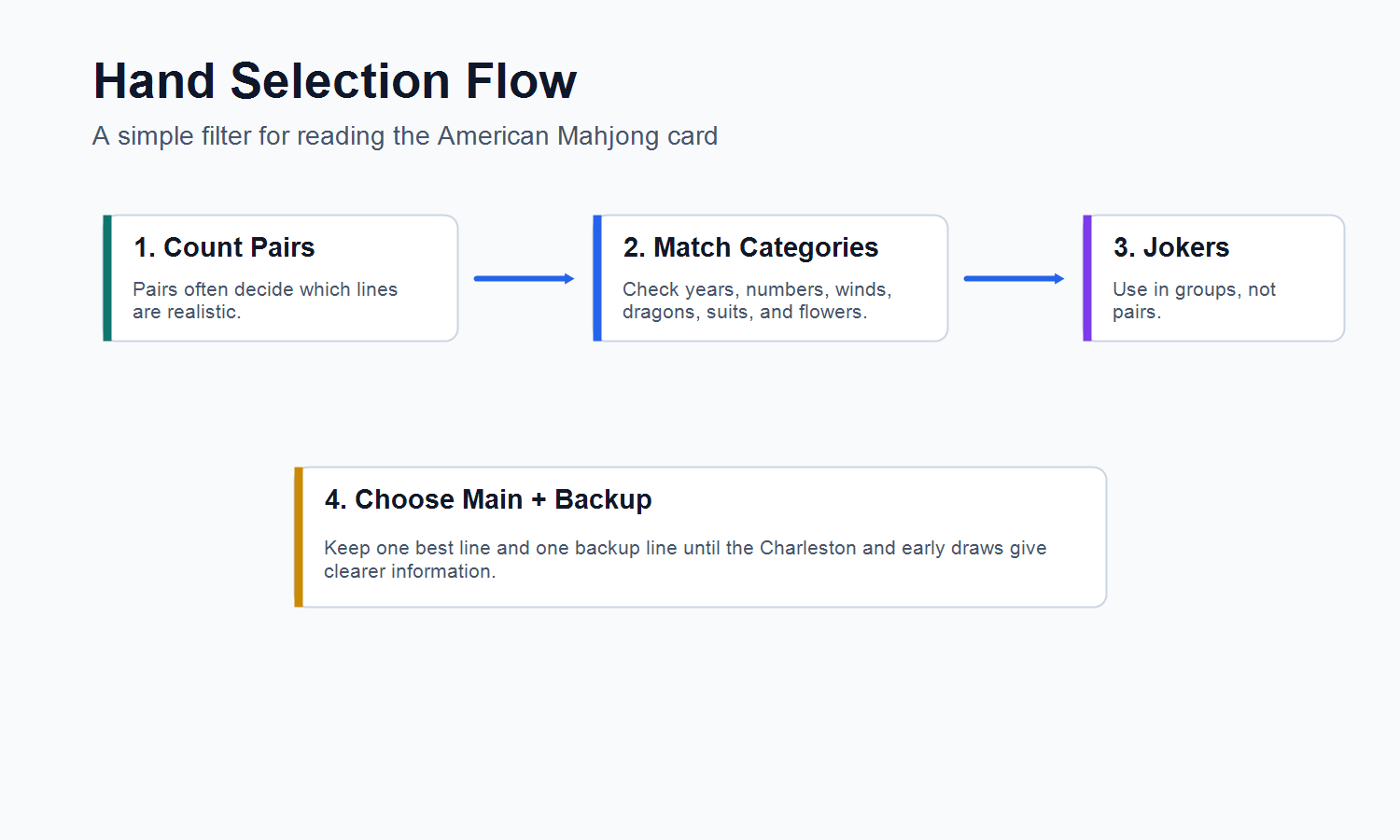
Step 3: Count Natural Pairs Carefully
Pairs deserve extra attention because jokers usually cannot complete them. A hand that needs several pairs is hard if you do not already have natural matching tiles.
This does not mean pair hands are bad. It means they should be chosen for the right reason. If your rack naturally starts with the pairs, a pair-heavy line may be strong. If you only have jokers, it may be weaker than it looks.
For deeper pair decisions, read when to break a pair in Mahjong.
Step 4: Use Jokers Without Overtrusting Them
Jokers are powerful, but they should not choose the hand for you. They make grouped hands more realistic, especially pungs, kongs, quints, and larger groups. They are much less helpful when a line depends on pairs or singles.
Before you commit to a joker-heavy plan, check whether the hardest part of the hand can actually use jokers. If the hardest part is two pairs, the joker may not solve your problem.
The full Mahjong joker rules guide explains these limits in detail.
Step 5: Choose a Main Hand and a Backup
Beginners often want to choose one exact hand too early. A better approach is to choose a main hand and keep one backup line alive. The backup protects you if the Charleston or early draws point in a different direction.
Your main and backup should share tiles when possible. If both lines use flowers and the same number family, you can stay flexible longer. If they require completely different tiles, you may need to choose sooner.
| Hand Choice | Good Sign | Warning Sign |
|---|---|---|
| Main hand | Uses several tiles already in your rack. | Needs many exact tiles you do not have. |
| Backup hand | Shares key tiles with the main hand. | Pulls your rack in a completely different direction. |
| High-value hand | Your rack naturally supports its restrictions. | You are chasing it only because the point value is higher. |
| Fast hand | Needs fewer exact draws and allows safe calls. | Scores less but gives you a realistic path. |
Step 6: Use the Charleston as Information
The Charleston is not just tile cleanup. It is information. The tiles you receive can confirm your plan, weaken it, or open a better one.
After each pass, ask: Did I receive tiles that support my main hand? Did I receive a stronger clue for my backup? Did I give away a tile that means my first idea is now less realistic?
If the passing order still feels confusing, review the Charleston in Mahjong before practicing hand selection.
When to Pivot to a Different Hand
Pivoting means changing your target hand when new evidence points somewhere better. Good players do this calmly. They do not stay loyal to the first hand just because it looked promising for two minutes.
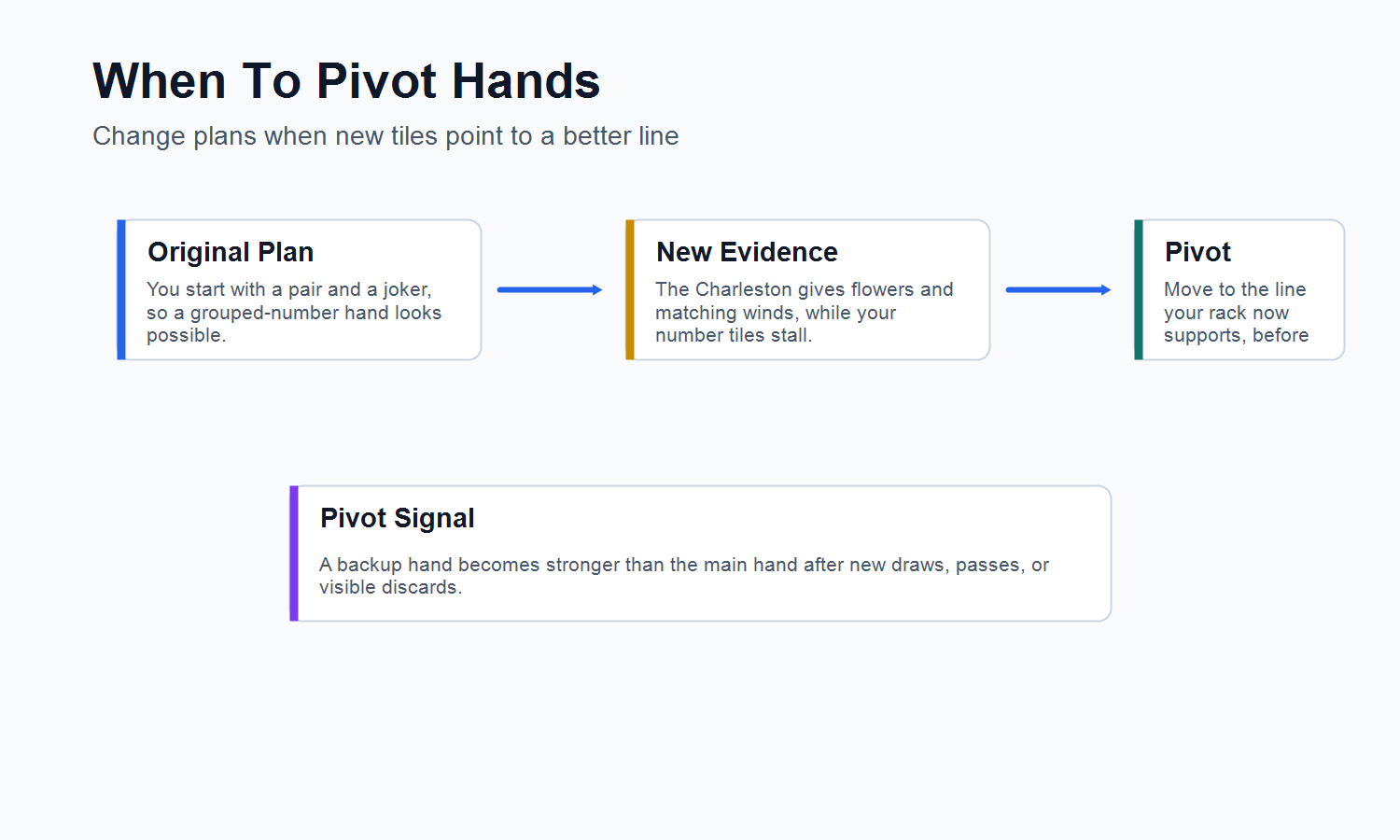
- Pivot if your main hand needs too many exact tiles and your backup is improving.
- Pivot if key tiles for your hand are visible in discards or exposures.
- Pivot if the Charleston gives you a strong new pair or flower direction.
- Pivot if your joker no longer helps the line you wanted.
- Do not pivot every turn. Too much switching can leave you with no plan.
How Scoring Should Influence Hand Choice
Point value matters, but it should not override practicality. A lower-value hand that your rack can finish is usually better than a higher-value hand that needs perfect luck.
When comparing two realistic hands, scoring can be the tiebreaker. When only one hand is realistic, let the rack be honest. The separate guide to American Mahjong scoring explains points and payouts for beginners.
Common Hand Selection Mistakes
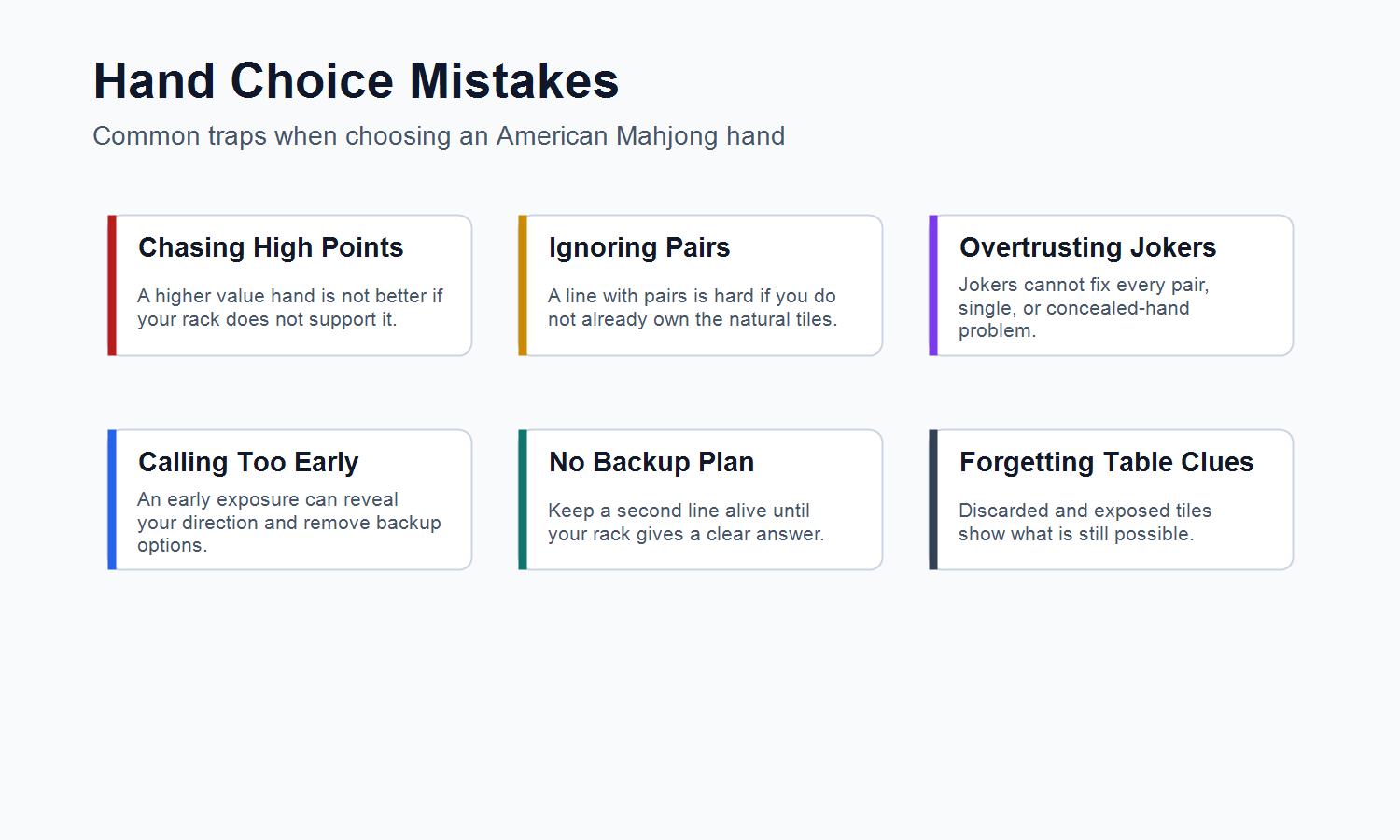
Hand selection mistakes usually come from forcing the card instead of listening to the rack. The card gives options; your tiles decide which options are practical.
| Mistake | Why It Hurts | Better Habit |
|---|---|---|
| Chasing high points | The hand may be unrealistic for your rack. | Choose the hand your tiles support first. |
| Ignoring natural pairs | Pair requirements are hard to fix later. | Count pairs before trusting jokers. |
| Calling too early | An exposure can reveal your plan and kill backup options. | Call only when it clearly advances a valid hand. |
| No backup plan | One bad draw can leave you stuck. | Keep one related backup line alive early. |
| Ignoring visible tiles | Your needed tiles may already be unavailable. | Watch discards and exposures as the hand develops. |
A Simple Practice Drill
Deal yourself 13 tiles and sort them. Without playing, write down two possible card lines: one main hand and one backup. Then draw one random tile at a time and ask whether your choice got stronger or weaker.
This drill trains the decision process without table pressure. It also helps you see why a hand that looked good before the Charleston may not be the right hand after a few new tiles.
FAQ
Should I choose a hand before the Charleston?
You can choose a direction, but stay flexible. The Charleston may strengthen your plan or point you toward a better one.
Should beginners choose high-value hands?
Only when the rack supports them. A high-value hand that needs too many exact tiles is usually worse than a lower-value hand you can realistically complete.
How many backup hands should I keep?
One related backup is usually enough for beginners. Too many options can make every discard feel stressful.
Do jokers make any hand a good choice?
No. Jokers help groups, but they usually do not complete pairs or singles. Always check the card line before relying on them.
When should I stop switching hands?
Once you have called and exposed tiles, or once your rack strongly supports one line, switching becomes harder. Early flexibility is useful; late indecision is costly.
Final Takeaway
Choosing a hand in American Mahjong is a practical filter: sort the rack, scan the matching card sections, count natural pairs, use jokers wisely, and keep a backup. Let your tiles tell you which hand is realistic, then let scoring help only after you have real options.
For quick table reminders while practicing, keep the Mahjong cheat sheet open nearby.