American Mahjong vs Chinese Mahjong: Key Differences for Beginners
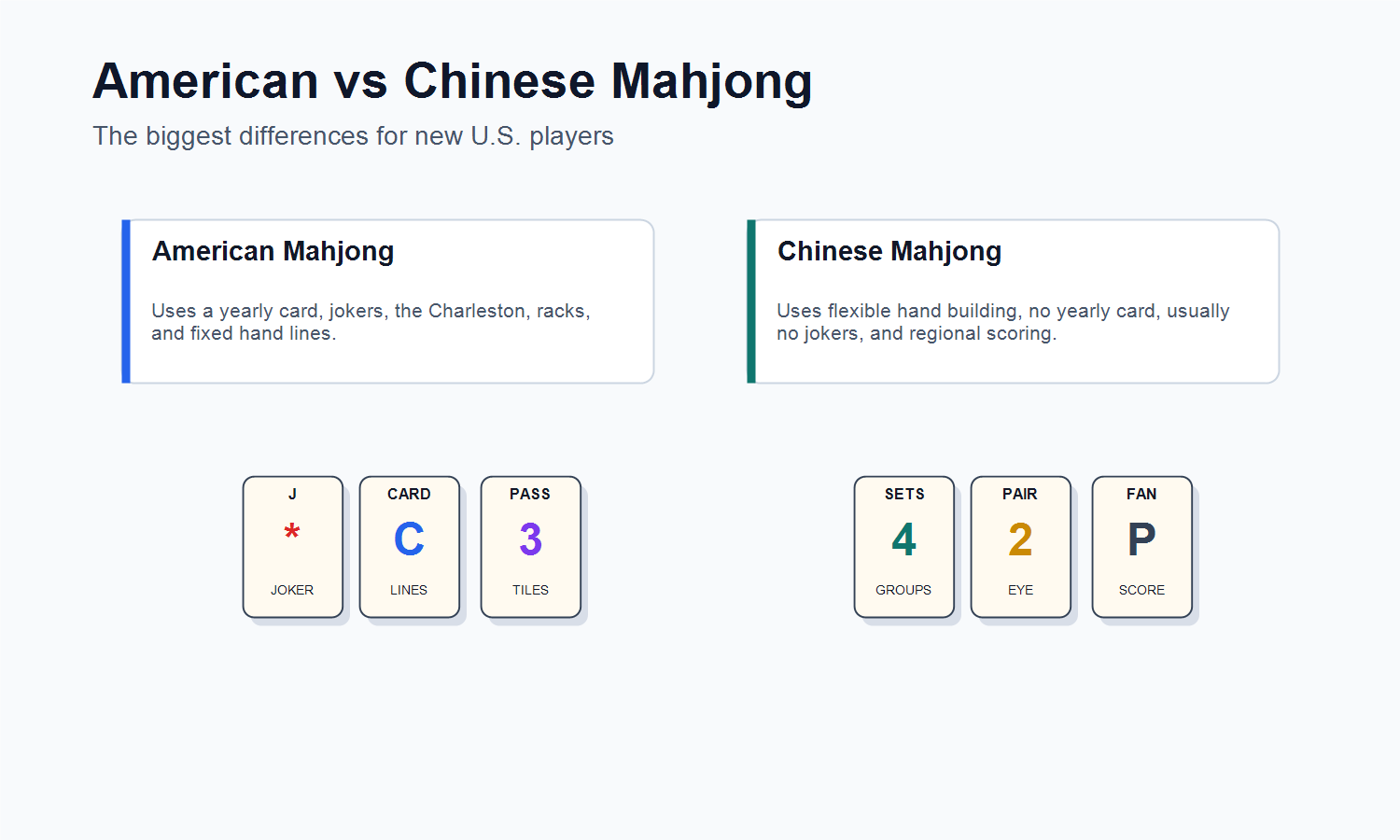
American Mahjong vs Chinese Mahjong is a common question for new U.S. players because the two games use many of the same tiles but feel very different at the table. American Mahjong is card-driven, uses jokers, and begins with the Charleston. Chinese Mahjong is more flexible, usually has no jokers, and depends heavily on the local rule set.
If you are choosing which version to learn first, the answer depends on your table. If your friends use the yearly card, learn American Mahjong. If your group wants a more traditional draw-and-discard game with flexible hand building, Chinese Mahjong may feel more natural.
Quick Comparison
The shortest answer is this: American Mahjong asks, “Which line on the card am I building?” Chinese Mahjong asks, “Which groups and scoring patterns can this hand become?” That one difference changes setup, strategy, pace, and scoring.
| Feature | American Mahjong | Chinese Mahjong |
|---|---|---|
| Main guide | Current yearly card | Chosen regional or house rule set |
| Jokers | Yes, with limits | Usually no standard jokers |
| Charleston | Yes, before discards begin | No |
| Winning hands | Must match a card line | Often four sets plus one pair, with regional patterns |
| Scoring | Card value plus table payout rules | Varies widely by style, such as Hong Kong, MCR, or Taiwanese |
| Learning feel | More structured once you can read the card | More open once you understand hand shapes |
The Biggest Practical Difference
American Mahjong gives you a menu of legal hands on the card. Your job is to sort your rack, choose a possible line, protect the tiles that line needs, and use jokers carefully when the line allows them.
Chinese Mahjong usually gives you more freedom in hand building. You are not matching a yearly card line. Instead, you form legal groups and then score the completed hand according to the table’s rules.
For a full American rules walkthrough, see American Mahjong rules. For the traditional setup and turn rhythm, read Chinese Mahjong rules.
Tile Set Differences
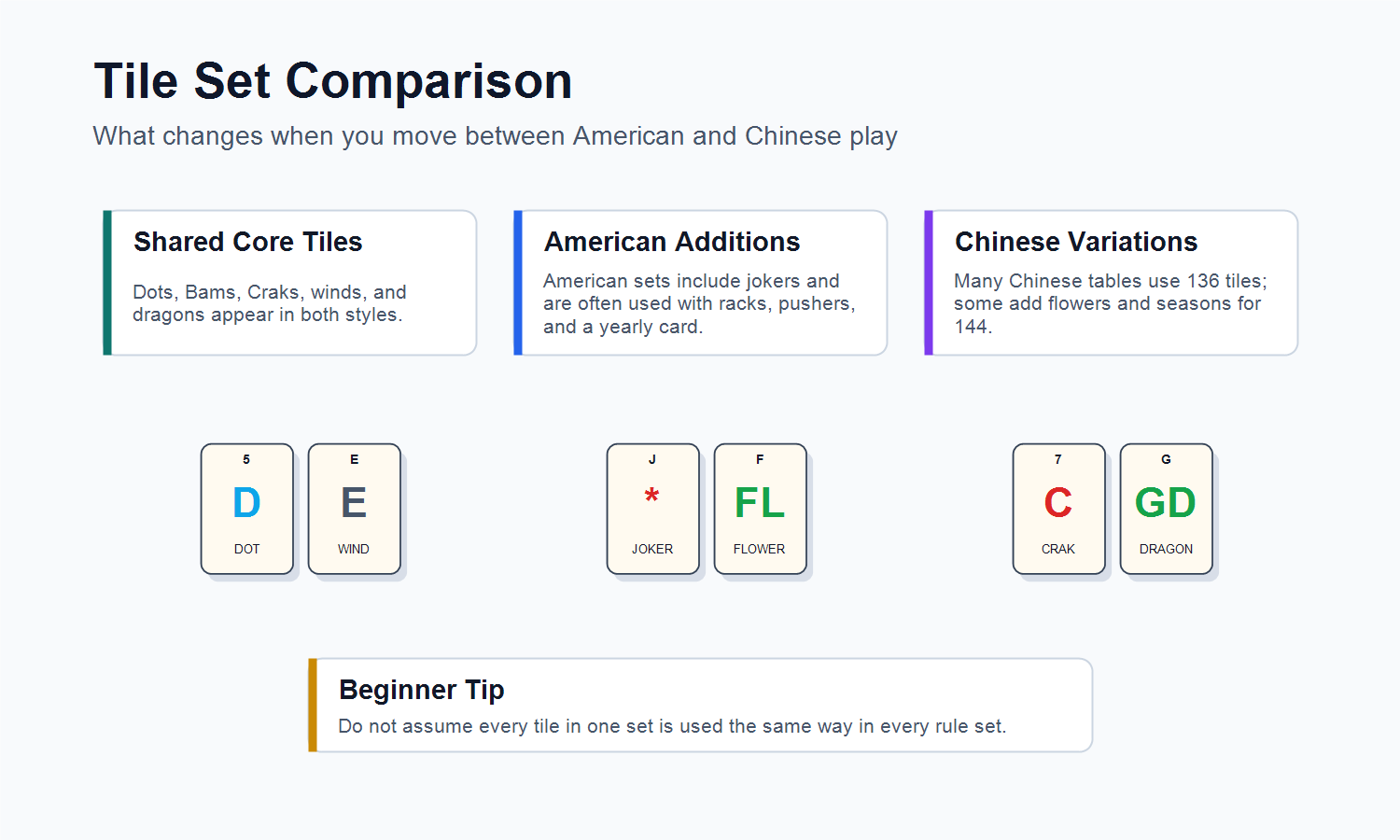
Both games share many familiar tiles: Dots, Bams, Craks, winds, and dragons. That shared vocabulary is why the games look similar at first glance.
The differences show up quickly. American Mahjong sets include jokers and are commonly played with racks, pushers, and a current card. Chinese Mahjong sets often use 136 tiles, or 144 when flowers and seasons are included, depending on the table.
If the tile names are still new, this Mahjong tiles guide can help you get comfortable with the vocabulary before you compare rule sets.
Setup and the Opening of the Game
American Mahjong has a planning phase before the first discard. After the tiles are dealt, players sort their racks and pass tiles through the Charleston. Those passes can strongly shape the hand you choose.
Chinese Mahjong usually reaches open play faster. After the walls are built and starting hands are dealt, East begins the round and players move into the draw-and-discard rhythm.
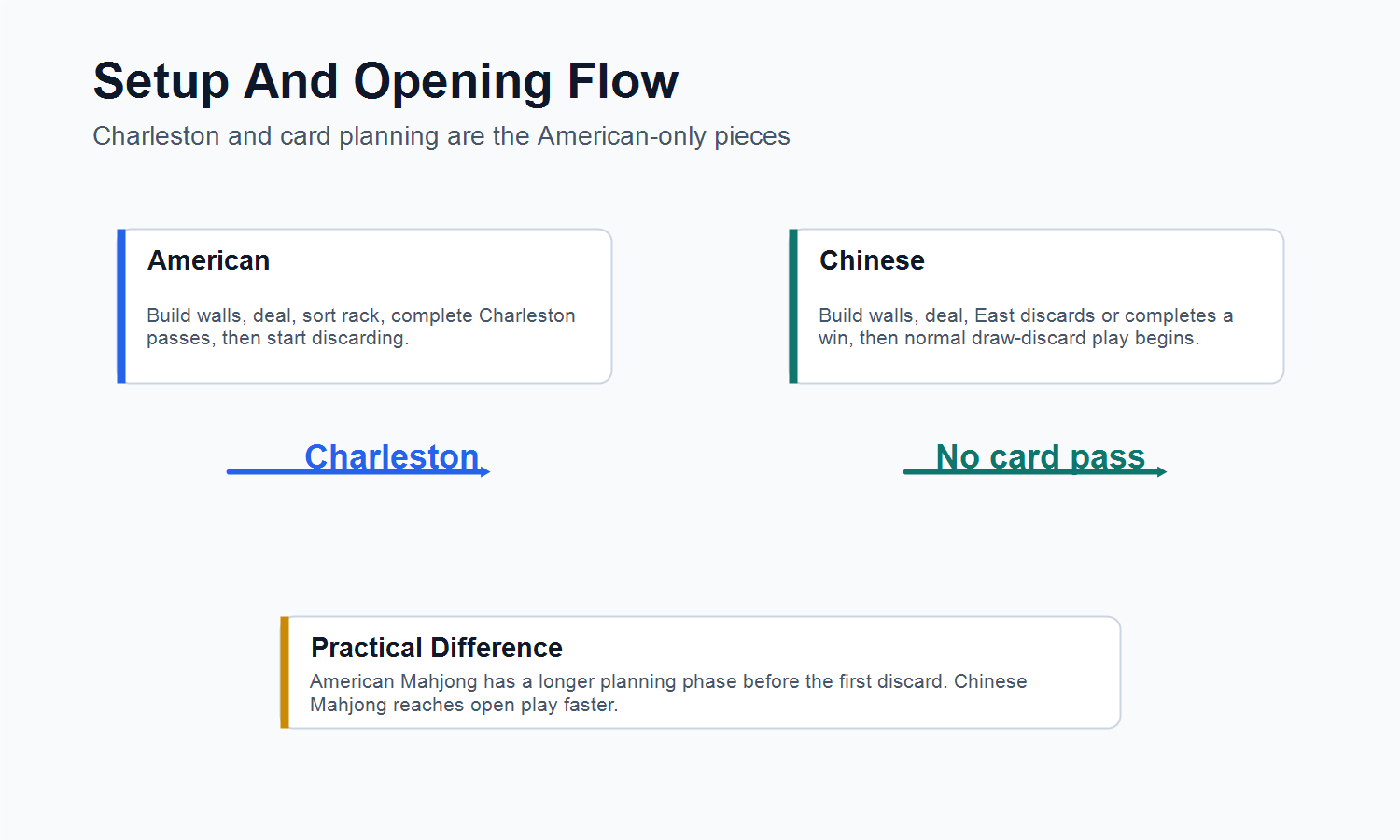
The Charleston is one of the most important American-only differences. If you play with U.S. groups, review the Charleston in Mahjong before your first game.
Winning Hands
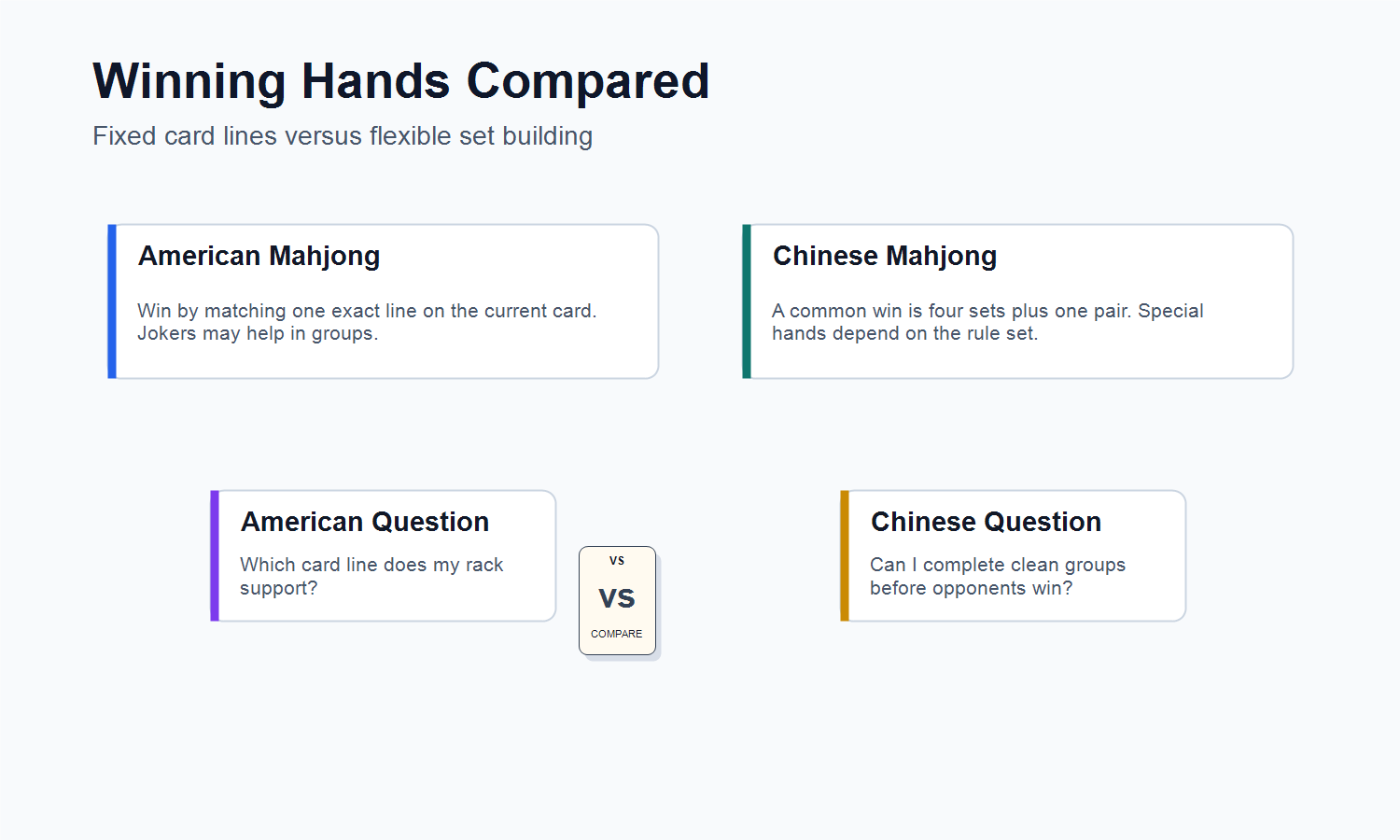
In American Mahjong, a winning hand must match one line on the current card. The card tells you which tiles, suits, groups, and exposure rules are allowed. A hand that looks organized can still be invalid if it does not match the card.
In Chinese Mahjong, the most useful beginner pattern is four sets plus one pair. A set may be a chow, pung, or kong. Many Chinese rule sets also score special patterns, but the table’s chosen rules decide which hands qualify and how much they are worth.
How This Changes Your Thinking
In American Mahjong, you often choose a direction early because the card lines are specific. You protect pairs, watch exposures, and avoid locking yourself into a dead hand.
In Chinese Mahjong, you may switch more fluidly between sequences and triplets as the wall and discards change. The key question is not only “Can I win?” but also “Does this hand meet the scoring requirement for our rule set?”
Jokers and Special Tiles
American Mahjong uses jokers as flexible tiles, but they have limits. They usually help in groups of three or more, while pairs and singles often require natural tiles.
Chinese Mahjong usually does not use jokers in standard beginner play. Flowers and seasons may appear, but they are not wild tiles in the American sense. Their scoring treatment depends on the rules at your table.
If you are learning American Mahjong, the Mahjong joker rules are worth reading early. Joker mistakes are one of the fastest ways for a new American player to build an invalid hand.
Scoring Differences
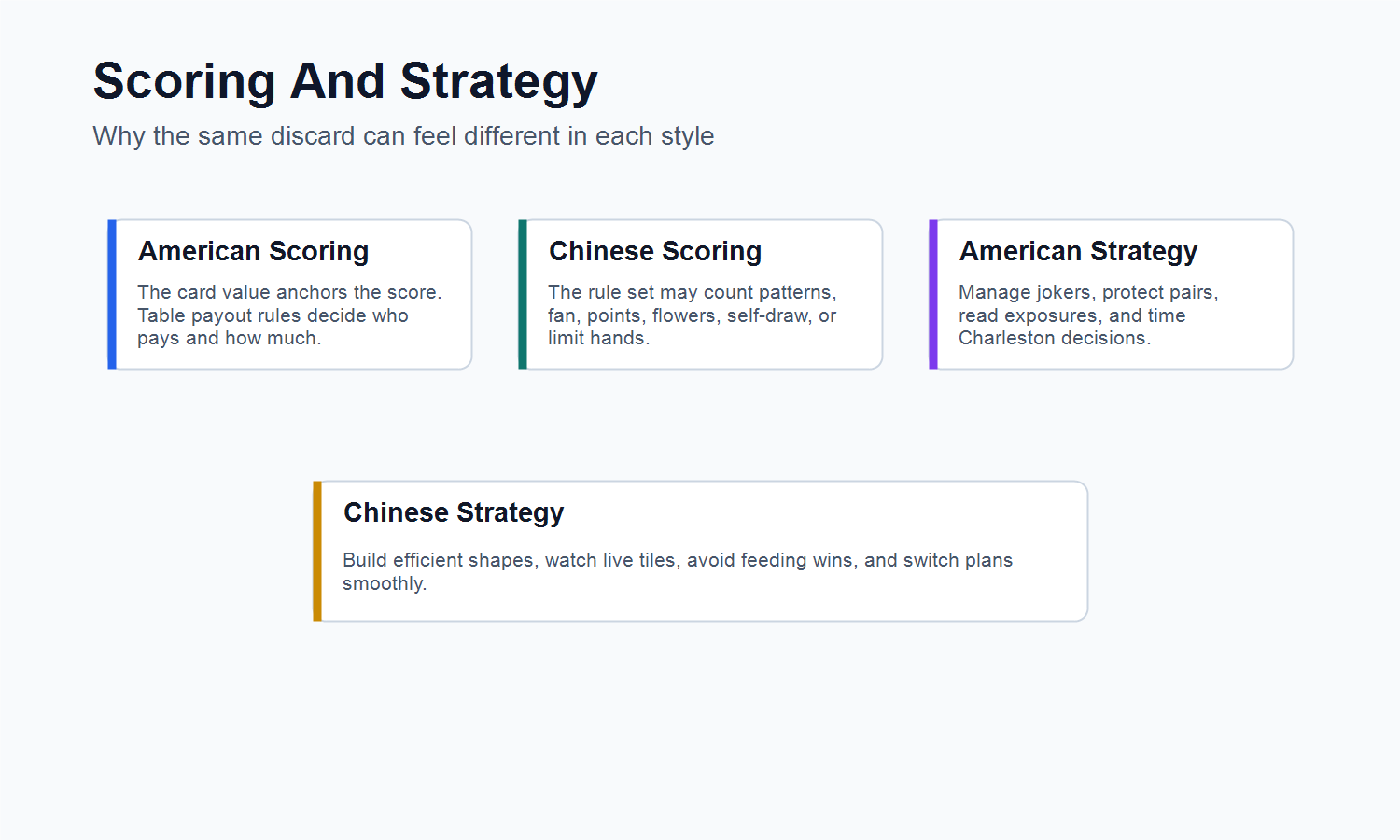
American Mahjong scoring starts with the point value printed beside the winning hand on the card. Then the table applies its payout habits for self-pick wins, discard wins, or friendly score-only games.
Chinese Mahjong scoring is less universal. Hong Kong style, Mahjong Competition Rules, Taiwanese Mahjong, and family house rules can all score the same-looking hand differently. This is why Chinese Mahjong groups should agree on one rule sheet before tiles move.
For American scoring examples, see American Mahjong scoring. For Chinese Mahjong, ask your table whether you are using Hong Kong style, MCR, Taiwanese rules, or a simplified home version.
Strategy: What Feels Different at the Table?
American Mahjong strategy often centers on card reading, joker timing, exposure safety, and Charleston decisions. You are balancing your chosen line against what other players reveal.
Chinese Mahjong strategy leans more into tile efficiency, flexible shapes, live tile awareness, and defensive discards. You still read opponents, but you are not comparing every exposure to a printed card line.
| Situation | American Mahjong Habit | Chinese Mahjong Habit |
|---|---|---|
| Opening hand | Sort toward likely card lines. | Look for efficient sequences, pairs, and triplet chances. |
| Discard decision | Protect card-line needs and avoid helping visible exposures. | Watch live tiles, dangerous suits, and possible waits. |
| Calling a discard | Check whether the card line allows exposure. | Check whether opening the group improves speed or gives away too much. |
| Late hand | Confirm the exact card line and joker limits. | Balance winning chances against feeding another player’s win. |
Which Version Should You Learn First?
Learn the version your real table plays. That sounds obvious, but it saves a lot of frustration. A player who studies Chinese Mahjong all week may still feel lost at an American Mahjong table if everyone else is using the yearly card and Charleston.
| Your Situation | Start With | Why |
|---|---|---|
| Your local club uses the yearly card. | American Mahjong | You need card reading, jokers, and Charleston habits right away. |
| Your family plays traditional Chinese rules. | Chinese Mahjong | You need the local scoring system and flexible hand shapes. |
| You want the simplest first lesson. | Either, with a teacher | A clear teacher matters more than the label on the variant. |
| You want to play in U.S. social groups. | Often American Mahjong | Many U.S. beginner tables use American rules, racks, and the card. |
Common Misunderstandings
- “They are basically the same game.” They share tiles, but the legal hands, setup, and scoring can be very different.
- “Chinese Mahjong always uses 144 tiles.” Some tables do, but many use 136 tiles without flowers and seasons.
- “American jokers work like wild tiles everywhere.” They are flexible, but they usually do not complete pairs or singles.
- “Chinese Mahjong has one universal scoring system.” It does not. Always ask which regional or house rules are being used.
- “The Charleston is part of all Mahjong.” It is an American Mahjong feature, not a standard Chinese Mahjong step.
FAQ
Is American Mahjong easier than Chinese Mahjong?
It depends on how you think. American Mahjong gives you a card, which adds structure but also requires exact pattern matching. Chinese Mahjong has a simpler basic hand shape, but scoring and defense can become deep quickly.
Can I use an American Mahjong set to play Chinese Mahjong?
Often yes, as long as the set includes the needed suit, wind, and dragon tiles. You may simply ignore jokers and any tiles your Chinese rule set does not use.
Does Chinese Mahjong have the Charleston?
No. The Charleston is part of American Mahjong. Chinese Mahjong usually begins regular play after the walls are built and starting hands are dealt.
Do both games use flowers?
American Mahjong includes flowers as part of the card system. Chinese Mahjong may use flowers and seasons in some styles, but not every table includes them.
Which game is better for beginners in the United States?
If your goal is to join U.S. social groups, American Mahjong may be more practical. If you are learning with family or friends who play Chinese rules, start there. The best first version is the one you can practice with real people.
Can learning one version help with the other?
Yes. Tile recognition, discard awareness, and table rhythm carry over. Just be careful not to carry over variant-specific rules, especially jokers, the card, the Charleston, and scoring.
Final Takeaway
American Mahjong and Chinese Mahjong are close relatives, not interchangeable rule sets. American play is built around the current card, jokers, and the Charleston. Chinese play is built around flexible hand shapes and the scoring system chosen by the table.
Once you know which table you are joining, learning gets much easier. Focus on that version first, then use the other as a way to deepen your overall Mahjong understanding.